5 Tips to Stop Waking Up Exhausted


(Family Features) It’s no secret that finding time for the recommended eight hours of sleep is easier said than done. More often than not, your time asleep is limited by your busy schedule. If you are lucky enough to squeeze in a full eight hours of shuteye, you are still not guaranteed to wake up feeling refreshed.

While some responsibilities are hard to shake, setting yourself up with the right routine can vastly improve your quality of sleep and combat the issues keeping you up at night:

1.     Lighten up: If it’s never light in your bedroom, you may be confusing your body’s circadian clock. The circadian clock regulates how alert you are due to the light and darkness in an environment. If you keep your bedroom dark during the day or use black-out curtains, this can act as a signal to your body that it should be asleep. Swap out your curtains for a lighter color or keep your shades partially open –natural sunlight in your room can help you wake up in the morning.

2.     Out with the old: Approximately half (49 percent) of Americans have had their mattress for five years or more and while people struggle with sleep for a variety of reasons, your mattress could be keeping you from getting a good night’s sleep. A quality mattress, like the Beautyrest Platinum Hybrid Mattress can give you the support you need to wake up feeling refreshed. It offers a “cool to touch” surface while also providing the support and pressure relief necessary to make sure that once you fall asleep, you stay asleep.

3.     Tune out: Everyone’s guilty of binge-watching their favorite TV shows from time to time. While you may satisfy your curiosity by catching the ending of your favorite series, you may not be so happy when you wake up groggy after staying up too late. Set an alarm for 30 minutes before you want to go to sleep and when the alarm goes off turn off your TV and get ready for bed. Limiting screen time before you fall asleep can also avoid disrupting your body’s level of melatonin, which controls sleep cycles.

4.     If you snooze, you lose: Hitting the snooze button even once in the morning can make you feel groggy throughout the day. By hitting snooze, you are prompting your body to start another stage in your sleep cycle without giving it enough time to fully recover. Try downloading an app with a smart alarm to make sure that you are waking up during a lighter stage of your sleep cycle.

5.     Cut the caffeine: While there is nothing quite like coffee for an afternoon pick-me-up, having caffeine after 2 p.m. can impact both your sleep quality and quantity. Instead of having a cup after lunch, take your coffee break earlier in the day or consider switching to decaf.

For more tips to wake up feeling refreshed, visit beautyrest.com

Florida airport shooting suspect inspired by Islamic State: media

Esteban Santiago is taken from the Broward County main jail as he is transported to the federal courthouse in Fort Lauderdale, Florida, U.S., January 9, 2017. Amy Beth Bennett/South Florida Sun Sentinel via REUTERS
(Reuters) - An Iraq war veteran accused of killing five people at a Florida airport told investigators he was inspired by Islamic State and previously chatted online with Islamist extremists, an FBI agent testified on Tuesday, U.S. media reported.

Esteban Santiago, 26, was ordered held in jail until a Jan. 30 arraignment, court records show. At that time he would enter a formal plea to charges that he opened fire in the baggage claim area of the Fort Lauderdale airport on Jan. 6.

"He has admitted to all of the facts with respect to the terrible and tragic events of Jan. 6," Assistant U.S. Attorney Rick Del Toro said at the federal court hearing in Fort Lauderdale, NBC 6 South Florida television reported. "These were vulnerable victims who he shot down methodically."

Reuters was not immediately able to reach U.S. prosecutors or the Federal Bureau of Investigation to confirm the media reports.

Santiago, a private first class in the National Guard who served in Iraq from 2010 to 2011, traveled from Alaska to Florida with a handgun and ammunition in his checked luggage, officials said.

Upon retrieving his gun case from the luggage carousel, he went to a bathroom to load the weapon and then opened fire on others waiting for their bags, investigators said.

FBI special agent Michael Ferlazzo testified Santiago told interrogators he carried out the attack on behalf of Islamic State and that he had been in contact with others on jihadist chat rooms who were planning attacks.

"It was a group of like-minded individuals who were all planning attacks," Ferlazzo said, according to NBC 6.

The FBI has said Santiago previously displayed erratic behavior, entering the FBI office in Anchorage in November and saying his mind was being controlled by a U.S. intelligence agency.

The FBI turned him over to local police, who took him to a medical facility for a mental evaluation, officials said.  

Police took a handgun from him but returned it last month after a medical evaluation found he was not mentally ill, authorities said.

Santiago used the same weapon in the airport attack, agents testified, the Sun Sentinel reported.

His defense team did not challenge the prosecution's argument that Santiago posed a flight risk and said he was prepared to be detained through his trial, CNN said.


 (Reporting by Daniel Trotta in New York; Editing by Colleen Jenkins and Lisa Shumaker)

Obama shortens sentence of Manning, who gave secrets to WikiLeaks

Chelsea Manning is pictured in this 2010 photograph obtained on August 14, 2013.Courtesy U.S. Army/Handout via REUTERS
By Roberta Rampton and Ayesha Rascoe

WASHINGTON (Reuters) - President Barack Obama on Tuesday shortened the prison sentence of Chelsea Manning, the former U.S. military intelligence analyst who was responsible for a 2010 leak of classified materials to anti-secrecy group WikiLeaks, the biggest such breach in U.S. history.

A White House official said there was no connection between Manning's commutation and renewed U.S. government concern about WikiLeaks' actions during last year's presidential election, or a promise by founder Julian Assange to accept extradition if Manning was freed.

Manning has been a focus of a worldwide debate on government secrecy since she provided more than 700,000 documents, videos, diplomatic cables and battlefield accounts to WikiLeaks - a leak for which she was sentenced to serve 35 years in prison.

Obama, in one of his final acts before leaving office, reduced her sentence to seven years, angering some Republicans.

"This is just outrageous," House of Representatives Speaker Paul Ryan said in a statement. Ryan, a Republican, said the decision was a "dangerous precedent" for those who leak materials about national security.

"Chelsea Manning's treachery put American lives at risk and exposed some of our nation's most sensitive secrets," Ryan said.

Manning was working as an intelligence analyst in Baghdad in 2010 when she gave WikiLeaks a trove of diplomatic cables and battlefield accounts that included a 2007 gunsight video of a U.S. Apache helicopter firing at suspected insurgents in Iraq, killing a dozen people including two Reuters news staff.

Republican Senator Tom Cotton said the leak endangered troops, intelligence officers, diplomats and allies.

"We ought not treat a traitor like a martyr," Cotton said.


TOOK RESPONSIBILITY

Manning, formerly known as U.S. Army Private First Class Bradley Manning, was born male but revealed after being convicted of espionage that she identifies as a woman. The White House said her sentence would end on May 17 this year.

Manning, who twice tried to kill herself last year and has struggled to cope as a transgender woman in the Fort Leavenworth, Kansas, men's military prison, accepted responsibility for leaking the material -- a factor that fed into Obama's decision, a White House official told reporters, speaking on condition of anonymity.

The official said Obama's decision was rooted in Manning's sentence being longer than sentences given to others who had committed comparable crimes. Obama, who leaves office on Friday and is scheduled to give his final news conference on Wednesday, is expected to discuss his decision then.

WikiLeaks also published emails in the weeks leading up to the Nov. 8 presidential election that U.S. intelligence agencies have concluded that Russian intelligence agencies hacked the Democratic National Committee and the accounts of leading Democrats, part of a campaign by Moscow to influence the election.

But Obama's decision had nothing to do with the latest WikiLeaks controversy, the White House official said.

"The president's decision to grant clemency and offer commutation to Chelsea Manning was not influenced in any way by public comments from Assange or the WikiLeaks organization," a White House official said on a conference call with reporters.

Assange has been holed up at Ecuador's London embassy since 2012 to avoid extradition to Sweden for the investigation of allegations, which he denies, that he committed rape there in 2010. He has said he fears Sweden would extradite him to the United States, where there is an open criminal investigation into the activities of WikiLeaks.

WikiLeaks sent a tweet quoting Assange's attorney, Melinda Taylor, saying he would abide by his promise to accept extradition if Manning was freed. "Everything that he has said he's standing by," Taylor said, according to the tweet.

Civil rights groups praised the move, calling it overdue.

"Chelsea Manning exposed serious abuses, and as a result her own human rights have been violated by the U.S. government for years," said Margaret Huang, executive director of Amnesty International USA.


STUXNET

Obama also pardoned retired U.S. Marine Corps General James Cartwright who pleaded guilty in October to making false statements to the FBI during an investigation into leaks of classified information.

The aggressive prosecution of Cartwright, who last served as vice chairman of the Joint Chiefs of Staff, sent shockwaves through the Pentagon.

He lied during questioning by the FBI over a book written by a New York Times reporter that exposed a malicious computer software program known as "Stuxnet" designed to disrupt Iran's nuclear program. Cartwright denied being the source of the leak.

Obama weighed Cartwright's service along with his motive when making the decision, the White House official said, noting Cartwright had not divulged material that the journalist was not already aware of, and that his conversations were focused on preventing the publication of material that could hurt national security.

"It's clear in this case ... that General Cartwright's motive was different than most people who are facing charges of leaking classified information to a journalist," the official said.


PUERTO RICAN MILITANT

Also on the pardon list: Oscar Lopez Rivera, who was sentenced in 1981 to 55 years in prison for his involvement with Puerto Rican militant group FALN, which claimed responsibility for dozens of bombings in the 1970s and 1980s.

Lopez Rivera -- who turned down a similar offer from President Bill Clinton in 1999 -- was the last remaining member of FALN still in prison.

"Mr. Lopez Rivera is now in his 70s. He has served 35 years, nearly half of his life in prison," a White House official said. "The president determined that was sufficient amount of time to serve, although the president certainly believes that the crimes that were committed were serious."

U.S. Senator Bernie Sanders campaigned for the release of Lopez Rivera during his unsuccessful campaign against Hillary Clinton for the Democratic presidential nomination.

Manning and Lopez Rivera were among 209 commutations granted by Obama on Tuesday and Cartwright was among 64 pardons.

In total, Obama has commuted sentences for 1,385 federal prisoners -- a total greater than that of the 12 previous presidents combined -- and he is expected to announce more on Thursday, the White House official said.

Most of the commutations were a part of Obama's effort to reduce the number of people serving long sentences for non-violent drug offenses.


 (Reporting by Roberta Rampton and Ayesha Rascoe; additional reporting by Phillip Stewart, Patricia Zengerle and Dustin Volz; Editing by Sandra Maler, Grant McCool and Lisa Shumaker)

Trump accuses civil rights leader Lewis of lying about inauguration

Rep. John Lewis (D-GA) testifies to the Senate Judiciary Committee during the second day of confirmation hearings on Senator Jeff Sessions' (R-AL) nomination to be U.S. attorney general in Washington, U.S., January 11, 2017. REUTERS/Joshua Roberts/File Photo
By Doina Chiacu

WASHINGTON (Reuters) - U.S. President-elect Donald Trump extended his war of words with African-American civil rights leader John Lewis on Tuesday, accusing the Democratic congressman of lying when he said Trump's inauguration would be the first that he would miss.

"John Lewis said about my inauguration, 'It will be the first one that I've missed.' WRONG (or lie)! He boycotted Bush 43 also because he 'thought it would be hypocritical to attend Bush's swearing-in....he doesn't believe Bush is the true elected president.' Sound familiar!" Trump said in a pair of posts on Twitter.

"He got caught in a very bad lie," Trump said in an excerpt of an interview broadcast on Fox News on Tuesday.

Lewis' office did not respond to a request for comment on Tuesday.

The Republican president-elect initially clashed with Lewis on Twitter over the weekend after the U.S. representative from Georgia questioned the legitimacy of his Nov. 8 election victory, because of U.S. intelligence agencies' conclusion that Russia meddled in the campaign.

Lewis also said he would not attend Trump's swearing-in this Friday and that "it will be the first one that I miss since I've been in the Congress."

Lewis' remarks, in an interview with NBC's "Meet the Press," were released last Friday at the beginning of the holiday weekend honoring slain black civil rights leader Martin Luther King Jr.

Trump responded on Saturday by tweeting that Lewis had falsely complained about the election results and instead "should spend more time on fixing and helping his district, which is in horrible shape and falling apart (not to mention crime infested)." Trump wrote dismissively that he was "all talk."

On Tuesday, Trump continued the battle, quoting an article in the Washington Post in 2001 that said Lewis spent  Inauguration Day in his Atlanta district rather than see Republican President George W. Bush sworn in.

Bush was declared the winner of the 2000 presidential election after the U.S. Supreme Court halted a protracted recount of a close race in Florida against Democrat Al Gore.

Trump's attacks on Lewis offended many Americans including some of Trump's fellow Republicans. Trump drew just 8 percent of the black vote in the November election.

The 76-year-old Lewis, who has been a civil rights leader for more than half a century, was beaten by police during a march he helped lead with King in 1965 in Selma, Alabama, drawing attention to hurdles for blacks to vote.

Maine's Republican governor, Paul LePage, chided Lewis on Tuesday in a radio interview, saying several Republican presidents had pursued civil rights reforms and Lewis should offer a simple word of thanks.

LePage, who has referred to himself as a proto-Trump political figure, has been involved in controversies including making racially charged statements and using obscenities.


 (Reporting by Doina Chiacu; Additional reporting by Eric Walsh and Eric Beech; Editing by Frances Kerry and Peter Cooney)

Why Obamacare’s ‘20 Million’ Number Is Fake

Liberals are notorious for caring about “groups” of people, but when it gets down to individual persons, not so much. You’re about to see this play out in spades as Democrats cry crocodile tears over the coming repeal of Obamacare.

You hear it over and over again: “This will be catastrophic for the 20 million people who were previously uninsured but now have coverage! You can’t take away their health care!”

First of all, no one is talking about doing that. Any repeal legislation will have a transition period for those who got coverage through Obamacare to move to new plans. And second, they will have more choices and better options. Win. Win.

But liberals would rather focus on quantity, how many millions we’ve given something to, versus quality, what does that “gift” mean for individual people.

The Obama administration claims 20 million more Americans today have health care due to Obamacare. The reality is that when you look at the actual net gains over the past two years since the program was fully implemented, the number is 14 million, and of that, 11.8 million (84 percent) were people given the “gift” of Medicaid.

And new research shows that even fewer people will be left without insurance after the repeal of Obamacare. Numbers are still being crunched, but between statistics released by the Congressional Budget Office and one of the infamous architects of Obamacare, the Massachusetts Institute of Technology’s Jonathan Gruber, it’s estimated that anywhere from 2 to 7 million people now on Medicaid would have qualified for the program even without Obamacare.

That further discredits the administration’s claim of 20 million more Americans having health insurance because of Obamacare.

Multiple studies have also shown that even those who are uninsured often have better outcomes than those with Medicaid. A University of Virginia study found that for eight different surgical procedures, Medicaid patients were more likely to die than privately insured or uninsured patients. They were also more likely to suffer complications.

And it is important to note that this study focused on procedures done from 2003-2007, prior to the geniuses in Washington deciding it was a good idea to put even more people on the already overburdened Medicaid system.

Additionally, despite what proponents of the law promised, there is little evidence to show that the use of emergency rooms, which have a higher level of medical errors, has decreased due to Obamacare.


Then there is this reality: While Obamacare has handed out millions of new Medicaid cards, that does not mean the recipients now have quality health care. In fact, it doesn’t ensure they have health care at all. That’s because increasing numbers of doctors aren’t accepting Medicaid.

As a Louisiana woman told The New York Times, “My Medicaid card is useless for me right now. It’s a useless piece of plastic. I can’t find an orthopedic surgeon or a pain management doctor who will accept Medicaid.”

Keep that in mind every time liberal Democratic senators pull out the Kleenex boxes bemoaning the fact Republicans are the ones trying to take people’s health care away.

Speaking of which, a much underreported fact of Obamacare is how many truly needy and disabled Americans are NOT getting the services they need because of the expansion of Medicaid for able-bodied adults (aka healthy) of prime working age, 19-54.

So while the left talks about all the new people Obamacare is helping, it neglects to mention that over half a million disabled people, from those with developmental disabilities to traumatic brain injuries, are on waiting lists for care.

And many of them are on waiting lists because Obamacare gives states more money to enroll able-bodied adults than it does to take care of disabled children and adults who qualified for Medicaid prior to Obamacare.

If you think that doesn’t have a real-world perverse impact, note this. Since Arkansas expanded its Medicaid program under Obamacare, it’s rolls have grown by 25 percent. During that same time, 79 people on the Medicaid waiting list who suffered from developmental disabilities have died. I would encourage you to read my former Heritage Foundation colleague Chris Jacob’s full piece on this.

Finally, it’s not just those enrolled in Medicaid that are finding fewer health care provider options. For people who now have health plans through the Obamacare exchanges, new Heritage Foundation research shows that this year, in 70 percent of counties across the country, those consumers will have only one or two insurers to choose from.

Add to that the millions of people who lost the doctors and health plans they liked and are now paying higher premiums for less coverage, and you can see that quality health care and anything resembling “choice” has quickly disappeared for an increasing number of Americans due to Obamacare.

So the next time a defender of Obamacare tries to take the moral high ground about the millions of people the law has helped, ask them to define what “help” looks like.

Commentary by The Daily Signal's Genevieve Wood. Genevieve Wood advances policy priorities of The Heritage Foundation as senior contributor to The Daily Signal. Send an email to Genevieve.

The Daily Signal depends on the support of readers like you. Donate now

Trump team doubles down on rebuke of civil rights leader

U.S. President-elect Donald Trump greets Vice President-elect Mike Pence during a news conference in the lobby of Trump Tower in Manhattan, New York City, U.S., January 11, 2017. REUTERS/Lucas Jackson
By Lucia Mutikani

WASHINGTON (Reuters) - Donald Trump's vice president and top aides on Sunday joined the U.S. president-elect in criticizing an historic civil rights activist and lawmaker for questioning the legitimacy of his election win, opening up a new divide days before the inauguration.

U.S. Representative John Lewis, a Georgia Democrat, told NBC's "Meet the Press" he thought hacking by Russians had helped Trump, a Republican, get elected in November. Lewis said he does not plan to attend Trump's swearing in on Friday, the first time he would miss such an event since being elected to the House in 1986.

Vice President-elect Mike Pence, incoming White House Chief of Staff Reince Priebus and Trump spokesman Sean Spicer characterized Lewis' remarks as disappointing and damaging to the reputation of U.S. democracy.

"We honor the sacrifice that he made," Pence said on CBS' "Face the Nation." "For someone of his stature not just in the civil rights movement but in voting rights to make a comment that he did not consider Donald Trump to be a legitimate president I think is deeply disappointing. I hope he reconsiders both statements."

Pence said he had attended both of President Barack Obama's inaugurations. He said at a time when the country was facing challenges both at home and abroad, Americans should look for ways to come together and work together.

The 76-year-old Lewis, who has been a civil rights leader for more than half a century, was beaten by police during a march he helped lead in 1965 in Selma, Alabama, drawing attention to hurdles preventing blacks from voting.

He protested alongside leader Martin Luther King Jr. that day and on other occasions. The spat comes ahead of Monday's federal holiday that honors King.

Speaking on ABC's "This Week", Priebus said Lewis' comments, given his position in society, were irresponsible.

"We need folks like John Lewis, and others who I think have been champions of voter rights, to actually recognize the fact that Donald Trump was duly elected," said Priebus. "I think putting the United States down across the world is not something that a responsible person does."


CONCERNS NOT TRIVIAL

Outgoing White House Chief of Staff Denis McDonough said Obama believed that Trump was the freely elected president. McDonough, however, said concerns raised by Lewis and other Democrats about Russia's interference in the election were not trivial.

"My hope would be that the president-elect will reach out to...John Lewis, who has done so many things over the course of his life, to try to work this out," McDonough said on CNN's State of the Union.

Such a gesture, he said, would show Americans that the nation is united and send a message to the Russians that "their efforts to divide us, to weaken us, to advance their own interests, at the expense of ours, are going to fail."

Trump's aides defended his hard-hitting response on Twitter on Saturday that Lewis "should spend more time on fixing and helping his district, which is in horrible shape and falling apart (not to mention crime infested)," instead of complaining about the Nov. 8 election results.

Lewis' district encompasses Atlanta and the city's main newspaper, the Atlanta Journal-Constitution, told Trump he was "wrong" in his characterization of the area, which includes "many of Atlanta’s crown jewels as well as pockets of poverty."  

"It was John Lewis that attacked Donald Trump. Donald Trump has a right to respond to that, and he did. And forcefully," Spicer said on Fox News.

But other Republicans and conservatives, like Senator Ben Sasse of Nebraska, had voiced support for Lewis on Saturday and his contribution not just to the United States, but to the world.  

At least 10 other Democratic U.S. politicians have said they also plan to skip the inauguration.


 (Reporting by Lucia Mutikani and Doina Chiacu; Editing by Phil Berlowitz and Mary Milliken)

Trump vows 'insurance for everybody' in replacing Obamacare

U.S. President-elect Donald Trump speaks during a news conference in the lobby of Trump Tower in Manhattan, New York City, U.S., January 11, 2017. REUTERS/Lucas Jackson

WASHINGTON (Reuters) - U.S. President-elect Donald Trump aims to replace Obamacare with a plan that would envisage "insurance for everybody," he said in an interview with the Washington Post published on Sunday night.

Trump did not give the newspaper specifics about his proposals to replace Democratic President Barack Obama's signature health insurance law, but said the plan was nearly finished and he was ready to unveil it alongside the leaders of the Republican-controlled Congress. The Republican president-elect takes office on Friday.

"It’s very much formulated down to the final strokes. We haven’t put it in quite yet but we’re going to be doing it soon," Trump told the Post, adding he was waiting for his nominee for health and human services secretary, Tom Price, to be confirmed.

The plan, he said, would include "lower numbers, much lower deductibles," without elaborating.

“We’re going to have insurance for everybody,” Trump said. “There was a philosophy in some circles that if you can’t pay for it, you don’t get it. That’s not going to happen with us.”

Trump was also quoted as saying in the interview that he would target pharmaceutical companies over drug pricing and insist they negotiate directly with the Medicare and Medicaid government health plans for the elderly and poor.

U.S. House Republicans won passage on Friday of a measure starting the process of dismantling the Affordable Care Act, popularly known as Obamacare, despite concerns about not having a ready replacement and the potential financial cost of repealing the law.

With the vote, Republicans began delivering on their promise to end Obamacare, also a campaign pledge of Trump, who has called the program a "disaster."

The law, which expanded health coverage to some 20 million people, has been plagued by increases in insurance premiums and deductibles and by some large insurers leaving the system.

Republicans have called Obamacare federal government overreach and have sought to undermine it in Congress and the courts since it was passed by Democratic majorities in the House and Senate in 2010.

Democrats say Obamacare has allowed growing numbers of Americans to get medical insurance and helped slow the rise in healthcare spending.


 (Writing by Mary Milliken; Editing by Will Dunham and Peter Cooney)

Fight Off the Flu


(Family Features) Colder weather and cold and flu season go hand-in-hand. While you may not be able to completely avoid getting sick, you can take some steps to protect yourself and minimize the chances of a serious illness.

The flu is a highly contagious illness that can result in hospitalization and even death. Managing your own risk of exposure to the flu not only protects you, but can help minimize the chances of passing on a potentially dangerous illness to those in higher risk groups. Those with compromised immune systems and risk factors such as age (both the elderly and young babies and children) and other health conditions are at an elevated risk.

Know the signs
It can be easy to confuse whether you’re fighting off symptoms of a common cold or a more serious bug like the flu. A common misconception is that the flu is defined by fever, vomiting and diarrhea. While these symptoms may be present with a case of the flu, the flu is primarily a respiratory illness. A variety of tests can help verify whether you have the flu, with varying degrees of reliability. Unless a definite determination is required and may affect your treatment (for example, if you are pregnant and need to avoid certain medications), chances are your doctor will not administer a test and will instead treat your symptoms.

Get vaccinated
The Centers for Disease Control and Prevention recommends that everyone 6 months and older get a yearly flu vaccine. Getting the vaccine early in the season is advisable because it can take as long as two weeks to be effective. Although the vaccination may not completely eliminate your chances of contracting the flu, it can minimize the severity of symptoms and reduce the likelihood of hospitalization due to the flu. Although the vaccine is available in both shot and nasal spray forms, the CDC recommends the shot as the preferred preventive method.

Other preventive steps
Although it is not always practical or possible, avoiding contact with those infected with the flu virus is an important preventive measure. The flu is very contagious and is thought to be transmitted in the droplets of saliva or nasal mucus that occur from coughs and sneezes. Encouraging those who are ill to cover their mouths with their sleeves or elbows (not hands, where germs are most easily transmitted) and regularly and thoroughly washing your hands can help reduce your risk, as well.

Treating the flu
Difficulty breathing, pain in the chest or abdomen, confusion, dizziness, severe vomiting and seizures are all indications that your illness requires immediate medical attention. Even if you aren’t experiencing these serious symptoms, you may benefit from a visit to the doctor, who can provide prescription antiviral drugs to shorten the length of your illness and help minimize the severity of symptoms. Other treatments include getting plenty of rest and preventing dehydration by drinking plenty of water or other clear fluids.

Find more cold weather tips for healthy living at eLivingToday.com.

4 Ways to Stretch Your Health Benefits
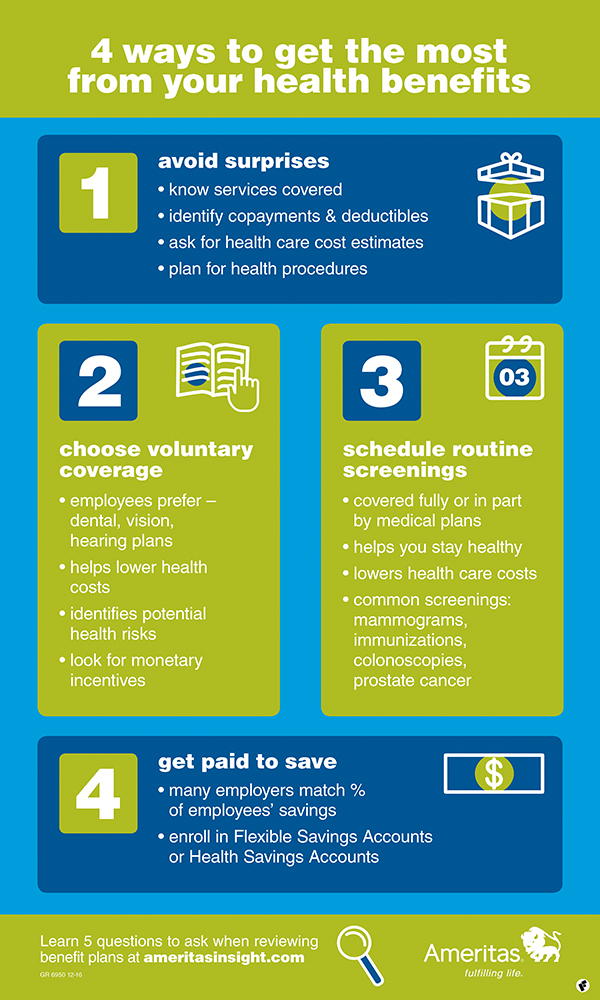
Often, employees enroll in medical insurance plans for protection against unpredictable events, sudden illness or serious health concerns that may result in expensive medical bills. Getting the most from your benefits requires understanding coverages and deductibles, as well as taking advantage of voluntary benefits, like dental, vision and hearing, to stay healthy and save money.

Avoid surprises. About 91 percent of adults in the United States are confused about what their benefits cover, according to a recent Harris poll. The best starting point is to review your plan so you understand the care and services covered. If you have a high-deductible plan, you will need to pay for most or a percentage of the health costs until reaching the individual or family deductible. Be prepared to pay any copayments or deductibles the plan requires before receiving care. Also, before scheduling appointments, ask for a cost estimate for the appointment, tests or service.

Preventive dental and vision. Many voluntary plans, such as dental and vision, offer preventive exams, such as routine cleanings and vision exams, that are fully covered. That’s because these preventive exams help to maintain and improve overall health and help reduce health costs. Voluntary coverage is affordable and many plans offer added incentives. For example, coverage for LASIK, dental, vision and hearing benefits can increase from one year to the next for those who continue to enroll and use their benefits. Members could earn monetary rewards to use for dental, vision, LASIK, orthodontia and hearing benefits, care materials and services simply by using their benefits and keeping the benefits paid out under a specified amount.

Medical screenings. Routine health screenings, such as mammograms, immunizations, colonoscopy procedures and prostate cancer screenings, which may be covered fully or in part by your medical coverage, can help you stay healthy and lower health care costs.

Get paid to save. Many employers encourage employees to save money by matching a percentage of the amount the employee contributes to the plan. If available, enroll in a Health Savings Account or Flexible Spending Account to set aside money to pay for health care costs.
Remember that these accounts are not a substitute for the coverage provided by voluntary benefits.

Learn more about the questions to ask when reviewing benefit plans at ameritasinsight.com.

Photos courtesy of Getty Images

SOURCE:
eLivingToday.com

4 Ways to Stretch Your Health Benefits


(Family Features) Often, employees enroll in medical insurance plans for protection against unpredictable events, sudden illness or serious health concerns that may result in expensive medical bills. Getting the most from your benefits requires understanding coverages and deductibles, as well as taking advantage of voluntary benefits, like dental, vision and hearing, to stay healthy and save money.


Avoid surprises. About 91 percent of adults in the United States are confused about what their benefits cover, according to a recent Harris poll. The best starting point is to review your plan so you understand the care and services covered. If you have a high-deductible plan, you will need to pay for most or a percentage of the health costs until reaching the individual or family deductible. Be prepared to pay any copayments or deductibles the plan requires before receiving care. Also, before scheduling appointments, ask for a cost estimate for the appointment, tests or service.

Preventive dental and vision. Many voluntary plans, such as dental and vision, offer preventive exams, such as routine cleanings and vision exams, that are fully covered. That’s because these preventive exams help to maintain and improve overall health and help reduce health costs. Voluntary coverage is affordable and many plans offer added incentives. For example, coverage for LASIK, dental, vision and hearing benefits can increase from one year to the next for those who continue to enroll and use their benefits. Members could earn monetary rewards to use for dental, vision, LASIK, orthodontia and hearing benefits, care materials and services simply by using their benefits and keeping the benefits paid out under a specified amount.

Medical screenings. Routine health screenings, such as mammograms, immunizations, colonoscopy procedures and prostate cancer screenings, which may be covered fully or in part by your medical coverage, can help you stay healthy and lower health care costs.

Get paid to save. Many employers encourage employees to save money by matching a percentage of the amount the employee contributes to the plan. If available, enroll in a Health Savings Account or Flexible Spending Account to set aside money to pay for health care costs.
Remember that these accounts are not a substitute for the coverage provided by voluntary benefits.

Learn more about the questions to ask when reviewing benefit plans at ameritasinsight.com.

Photo courtesy of Getty Images

SOURCE:
Ameritas

These Republicans voted to balance the budget. These Republicans voted to add $10 trillion in debt. Here's the list.

These Republican senators voted to balance the budget.
Crapo
Cruz
Daines
Flake
Kennedy
Lankford
Lee
Moran
Paul
Risch
Rubio
Sasse
Scott
Toomey

These Republican senators voted to add $10 trillion to the national debt.
Alexander
Barrasso
Boozman
Burr
Capito
Cassidy
Cochran
Collins
Corker
Cornyn
Cotton
Enzi
Ernst
Fischer
Gardner
Grassley
Hatch
Heller
Hoeven
Inhofe
Isakson
Johnson
McCain
McConnell
Murkowski
Perdue
Portman
Roberts
Rounds
Sessions
Shelby
Sullivan
Thune
Wicker
Young

Senate Roll Call Vote 3
(14-83) Rejected
On the Amendment S.Amdt. 1: Paul Amdt. No. 1; In the nature of a substitute. 

The Importance of Animal Antibiotics


Farmers use antibiotics in farm animals for the same reason antibiotics are used in people – to treat, control and prevent disease that causes pain and suffering. Keeping farm animals healthy helps improve food safety for all of us by reducing bacteria in the food supply. Learn more about the benefits of treating animals with antibiotics at animalantibiotics.org.

SOURCE:
Phibro Animal Antibiotics

Tips to Get Kids Outside and Away From Screens


Section Image

(Family Features) Remember taking off for a day of adventure on your bike, returning home only for dinner? Kids these days don't have the same incredible experience of exploratory, unstructured play. According to a new survey commissioned by Nature's Path, 54 percent of moms say their kids spend more time playing in front of a screen than playing outside.

"Playing outside in nature is critically important for kids' development. Research shows it improves everything from problem-solving to cognitive ability to social relations," said parenting expert Amy McCready, founder of Positive Parenting Solutions. "Between screen time and the busy schedules of both parents and kids, today's children are spending less time outside and missing out on this fun and beneficial part of childhood."

According to the survey, the majority of moms try to regularly get their kids outside to enjoy the lifelong learning and health benefits of playing in nature. The biggest barriers that prevent this are: fear of letting kids play outside alone, being too busy juggling other priorities and not having the time to supervise outdoor play.

Here are five fun ideas to get you and your kids outside and exploring nature:

1. Get crafty. Let your kids collect leaves, flowers, stones, pinecones or anything that strikes their fancy - and then craft together. Make leaf prints, press flowers between plastic sheets to create placemats, paint stones or sticks to look like animals or make a terrarium in a bottle. The possibilities are as endless as their imaginations.

2. Schedule it. Kids are used to planned sports and activities, so schedule an hour of outdoor play that they will come to expect. That's where the planning ends - give them some ideas, but let them use their imaginations and engage in unstructured free play.

3. Explore at night. Turn a simple walk around the neighborhood into an adventure by going outside in the evening. Let kids take flashlights and glow sticks to help explore nature in a whole new way. Talk about the sights and smells at night and look at the stars together.

4. Share your favorite activities and make new memories. When you were young, did you love to skip stones on a pond? Build a fort? Jump in to piles of leaves? Tell your kids about your favorite pastimes and experience them together.

5. Get schools involved. According to the survey, the vast majority of moms (94 percent) agree it's important that schools also help kids discover nature. Moms can help schools by bringing them a program that's easy to implement. Nature's Path EnviroKidz Ecokeepers is a hands-on, exploration-based program that blends a traditional activity passport for kids to fill-in with a modern-day treasure hunt that uses GPS on smartphones to find hidden caches. It's free for schools and camps, and complements science and physical education curriculum. Parents can also download the Ecokeepers explorer guide and resources featuring activities to do with the family. The geocache app can be downloaded free from geocaching.com or your smartphone's app store.

While busy schedules don't always make it easy for moms to do everything they'd like to do with their kids, a little planning can help to get kids outside to experience all the benefits of outdoor play.

SOURCE:
Nature’s Path

Plan Ahead to Manage Winter Outages


(Family Features)Ahead of the frigid winter weather blowing into cities and neighborhoods, families can take steps to prevent frozen pipes, spoiled food and the uncomfortable situations that arise when temperatures drop and a home’s power goes out.

Families that may endure a power outage this winter should remember these helpful tips to stay safe and comfortable.

Before the storm:

  • Stock-up on batteries and flashlights.
  • Evaluate the family’s non-perishable food supply and restock if necessary.
  • Review how to manually open the electric garage door.
  • Conduct a practice run to help ensure your family knows how to properly locate and operate any equipment required during the power outage.

During/after the storm:

  • Never use a gas stove, oven or grill to heat a home.
  • During the first few hours of the outage, keep the refrigerator and freezer closed. Snow can be used as ice to keep items cold in a cooler. 
  • Choose mittens over gloves and wear layered loose clothing to stay warm.
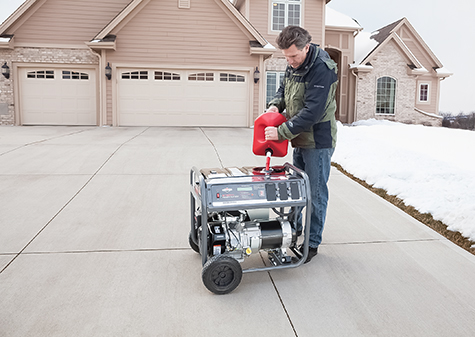
  • Always operate a portable generator outside of a home.

Alternate energy source
A loss of electricity poses one of the greatest potential dangers and inconveniences when a winter storm strikes.

“Having a backup power solution ready ahead of a utility power outage prevents most of the headaches that go with living without power. With backup power, families won’t necessarily need to worry about perishable foods going bad, for example,” said Dan Roche, director of marketing for portable power and cleaning systems at Briggs & Stratton. “This gives families the security they desire to comfortably ride out long winter months.”   

The most popular backup power solutions are portable generators and permanently-installed standby generator systems. Both types of backup power can keep a home’s lights, furnace and necessary appliances working in the event of a weather-related power outage or other emergency. Understanding the differences and capabilities between the two options can make selecting the best generator for a family’s needs much easier.

Portable generators are generally low maintenance, compact and easily maneuverable on the property. These units are typically powered by gasoline and can work well as a quick solution during a power outage to provide reliable electricity to a few essential items and appliances such as a refrigerator, basic light circuits and portable electric heaters at the same time.

While portable generators can provide users with flexibility and comfort, they need to be used appropriately at all times in order to avoid carbon monoxide poisoning. Never run a portable generator inside a home or in a garage. Visit TakeYourGeneratorOutside.com to learn more about portable generator safety.

Families who want a backup power source that offers uninterrupted power should opt for a home standby generator system. Home standby generators are permanently installed, so they need to be done by a professional. These generators are connected to a house’s existing propane or natural gas line. When utility power to a house is interrupted, the home generator automatically turns on within seconds. Home standby generators can power more of a home’s high-wattage appliances, like the furnace, electric water heater, stove and clothes dryer simultaneously, so your family doesn’t experience any interruptions during unexpected power outages.

For more backup power solutions and an interactive tool to aid in the decision-making process, visit briggsandstratton.com.

SOURCE:
Briggs & Stratton

5 Tips for Financial Fitness in 2017


(Family Features) If a commitment to improving finances is among your resolutions for 2017, you’re not alone.

A survey from the National Endowment for Financial Education (NEFE) shows that more than two-thirds of U.S. adults will make a financial resolution this year.

However, one out of three Americans said their financial quality of life is worse than they expect, as saving money and debt concerns top the list of stressors. Additionally, almost two-thirds of respondents experienced a financial setback in 2016, with transportation issues, housing repairs and medical care cited as the leading causes. For the nearly 50 percent of those who admit they’re living paycheck to paycheck, significant unplanned expenses can add up.

“To be successful with your financial resolutions in 2017, set thoughtful, realistic goals,” said Paul Golden, spokesperson for NEFE. “If your goal is to build an emergency savings, start with a small amount like $500 dollars to show yourself you actually can achieve that mark then set the bar higher. It’s not uncommon to be hit with an unexpected expense, so be prepared.”

These five tips can help get you on the path toward tackling your financial goals:

1. Get debt under control. Take a hard look at what you owe. If there are warning signs of too much debt, take action. Set a goal to reduce your debt next year by 5-10 percent. That might mean reducing impulse shopping, which six out of 10 people admit to doing, and 80 percent regret the purchases later. When you face temptation, walk away for at least 30 minutes to make sure you still want the item.

2. Start saving now. Ideally, you should have six to nine months of income set aside, but achieving a small goal can provide a sense of security and reduce stress. The rules of retirement have changed: Review your long-term savings and ensure they are appropriate and on target.

3. Shop for better services. Make a game out of shopping providers to find the best value in the services you use. How long has it been since you shopped your insurance policies? Is there any chance you can save money on your cell phone, internet or utilities? Visit current providers and ask, “What’s the best deal?” Be sure to understand your policies and services so that you are comparing fairly and accurately.

4. Understand what’s behind your financial decisions. If you’ve ever wondered why you feel good about spending money on vacations but avoid saving for retirement, the answer may lie in your unique values and how they influence your financial decision-making. Take the LifeValues Quiz at SmartAboutMoney.org.

5. Don’t be afraid to ask for help. Recruit a “financial buddy” and share your resolutions with a trusted family member or friend who can provide support in helping you meet your financial goals. Find someone who will hold you accountable and set a good example for you to follow.

For more help getting your finances in order, visit SmartAboutMoney.org.

Photo courtesy of Getty Images

SOURCE:
National Endowment for Financial Education

5 Lessons for Everyday Athletes from a U.S. Olympian


Section Image

(Family Features) Becoming a U.S. Olympic athlete requires an extraordinary combination of talent and perseverance, but there are lessons to be learned from these competitors that can help propel everyday athletes to reach the top of their game.

Among the 2016 Team USA roster, there were countless stories of triumph such as that of U.S. Olympic gymnast Danell Leyva, who was named an alternate for Team USA before stepping in for an injured teammate. Leyva ultimately competed and went on to bring home two silver medals in the parallel bars and horizontal bar individual events during the Rio 2016 Olympic Games.

Leyva knows what it takes to build a champion: a lifetime of determination and training, countless competitions and years of fueling his body with the right foods and beverages, like milk, which is packed with nine essential nutrients, including 8 grams of natural protein in each 8-ounce serving.

Even if your own athletic aspirations keep you closer to home, adopting the right mindset will help propel you to new heights in your athletic endeavors.

  1. Define your goals. In order to reach that pinnacle of success, you must know exactly what your end goal will be. Put it on paper and display it prominently so you are constantly reminded of the finish line. If you find yourself weary along the way, refocus your attention on the sense of victory that will come when you finally achieve success.
  1. Eat to win. A well-rounded and healthy diet is essential for any athlete, but ultimately it’s the right mix of nutrients that help them reach their peak. That includes protein, like the high-quality, natural protein in milk. In fact, U.S. Olympic Training Centers, where athletes are training at the highest level, serve tens of thousands of gallons of milk every year and nine out of 10 U.S Olympians said they drank milk while growing up.*

“Ever since I was young, I’ve always had milk in the morning,” Leyva said. “It’s an easy way to get protein and nutrients to help fuel my training, whether I am at home or at an international competition.”

  1. Dedicate the time. Top athletes know that champions are built, not born. That means putting in the time with training, practice and more practice to become the very best in their sport. For an everyday athlete, that may not mean dedicating hours each day to the cause, but it does mean making a serious commitment to bettering your game.
  1. Be prepared to overcome adversity. Elite athletes often find their road to the top scattered with bumps. Leyva is no exception; the alternate spot was a step away from the place on the Team USA roster he coveted. Sticking with his training and keeping his focus ensured he was ready to step up when the time came.
  1. Surround yourself with supporters. Very few successes in life are achieved alone. Create a team of supporters who motivate you to be your very best. This may include coaches and trainers, but also family members and friends who cheer you along your path to victory.

To learn more about the Milk Life campaign and watch exclusive behind-the-scenes videos of Team USA athletes, visit milklife.com/teamusa.

*Nine out of 10 finding based on 675 responses received from survey invitations sent to U.S. Olympians.

SOURCE:
MilkPEP

Kremlin says US hacking allegations are 'reminiscent of a witch hunt'

By Maria Tsvetkova and Christian Lowe

MOSCOW (Reuters) - Allegations that Russia tried to influence the U.S. election in favour of Donald Trump amount to a witch-hunt, the Kremlin said on Monday, in its first reaction to the release of a U.S. intelligence report on the alleged Russian operation.

The report, a redacted version of which was released publicly last week, alleged that Russian President Vladimir Putin directed a cyber campaign aimed at helping Trump beat his rival Hillary Clinton in the race for the White House.

Kremlin spokesman Dmitry Peskov said no new evidence had been produced to show that Russian officials was involved.

"We are observing a serious fatigue with these accusations," Peskov told reporters on a conference call. "It truly is reminiscent of a witch-hunt."

His words echoed a phrase used by Trump himself, who was quoted as saying in an interview with the New York Times newspaper on Friday that the storm over Russian hacking was a "political witch hunt."

Peskov, commenting on the U.S. intelligence report, said: "You know, that version of the report that was made public added no substance whatsoever that we can comment on."

"Groundless accusations which are not supported by anything are being rehearsed in an amateurish, unprofessional way. We don't know what information they are actually relying on."

Asked if Putin himself had read a translation of the report, Peskov said there was nothing in the document "that's worth reading in detail."

But Peskov said the Kremlin's position, as in the past, is that it categorically rules out that any Russian official could have been involved in hacking related to the 2016 U.S. presidential election.

Both Trump and Putin have said that they want to restore U.S.-Russian relations, and the Kremlin spokesman indicated that Moscow was looking beyond the hacking row and ahead to the new administration.

Peskov said there had been witch-hunts in the past in U.S. history, but those periods came to an end when what he described as more sober leaders took charge.

Peskov said that once Trump had been inaugurated on Jan. 20, work would begin on finding a date for a first meeting between the Russian and U.S. leaders.

"If some kind of contacts will be planned, then they will be planned extremely painstakingly, carefully, especially since we are talking about contacts following a very tense period in our relations," he said, referring to disputes between the Kremlin and the Obama administration.


 (Editing by Alexander Winning)

Trump acknowledges Russia role in US election hacking: aide

Photo: Reuters/Lucas Jackson
By Toni Clarke and Dustin Volz

WASHINGTON (Reuters) - President-elect Donald Trump accepts the U.S. intelligence community's conclusion that Russia engaged in cyber attacks during the U.S. presidential election and may take action in response, his incoming chief of staff said on Sunday.

Reince Priebus said Trump believed Russia was behind the intrusions into the Democratic Party organizations, although Priebus did not clarify whether the president-elect agreed that the hacks were directed by Russian President Vladimir Putin.

"He accepts the fact that this particular case was entities in Russia, so that's not the issue," Priebus said on "Fox News Sunday."

It was the first acknowledgment from a senior member of the Republican president-elect's team that Trump had accepted that Russia directed the hacking and subsequent disclosure of Democratic emails during the 2016 presidential election.

Trump had rebuffed allegations that Russia was behind the hacks or was trying to help him win, saying the intrusions could have been carried out by China or a 400-pound hacker on his bed.

With less than two weeks until his Jan. 20 inauguration, Trump has come under increasing pressure from fellow Republicans to accept intelligence community findings on Russian hacking and other attempts by Moscow to influence the Nov. 8 election. A crucial test of Republican support for Trump comes this week with the first confirmation hearings for his Cabinet picks.

A U.S. intelligence report last week said Putin directed a sophisticated influence campaign including cyber attacks to denigrate Democratic presidential candidate Hillary Clinton and support Trump.

The report, commissioned by Democratic President Barack Obama in December, concluded vote tallies were not affected by Russian interference, but did not assess whether it influenced the outcome of the vote in other ways.

'ACTION MAY BE TAKEN'

After receiving a briefing on Friday from leaders of the U.S. intelligence agencies, Trump did not refer specifically to Russia's role in the presidential campaign.

In a statement, he acknowledged that "Russia, China, other countries, outside groups and people are consistently trying to break through the cyber infrastructure of our governmental institutions, businesses and organizations including the Democrat(ic) National Committee."

Trump spokesman Sean Spicer told Reuters the president-elect's conclusions remained the same and that Priebus' comments were in line with Friday's statement.

Priebus’ wording did not appear to foreshadow the dramatic reversal of Trump’s apparent Russia policy that experts say would be required to deter further cyber attacks.

“It will take a lot more than what we heard on television today to make Putin cool it,” the expert added. “In fact, there may not be anything that can deter Putin from pursuing a course he’s bet his future and Russia’s on,” said a U.S. intelligence expert on Russia, speaking on condition of anonymity to discuss domestic political positions.

The expert added that Putin's "multifaceted campaign of cyber attacks and espionage, propaganda, financial leverage, fake news and traditional espionage" had expanded in the United States since the election, "and it will be a shock if it does not escalate in France, Germany and elsewhere this year."

Priebus, the former Republican National Committee chairman Trump tapped as White House chief of staff, said Trump planned to order the intelligence community to make recommendations as to what should be done. "Action may be taken," he said, adding there was nothing wrong with trying to have a good relationship with Russia and other countries.

Two senior Republican senators urged Trump to punish Russia in response to U.S. intelligence agencies' conclusion that Putin personally directed efforts aimed at influencing the election.

Appearing on NBC's "Meet the Press," Senators Lindsey Graham and John McCain said evidence was conclusive that Putin sought to influence the election - a point that Trump has refuted.

"In a couple weeks, Donald Trump will be the defender of the free world and democracy," Graham said. "You should let everybody know in America, Republicans and Democrats, that you're going to make Russia pay a price for trying to interfere."

On Saturday, Trump wrote on Twitter that having a better relationship with Russia was a "good thing."

U.S. Representative Devin Nunes, the Republican chairman of the House Intelligence Committee, said three U.S. presidents had tried and failed to be friends with Putin.

"I’m just not sure it’s possible," Nunes said on the "Fox News Sunday" program. "I’ve cautioned his administration to be careful with Putin, as he remains a bad actor."

Senate Majority Leader Mitch McConnell agreed it was not unusual for a new president to want to get along with the Russians. He added on CBS, however, that the Russians remained a "big adversary, and they demonstrated it by trying to mess around in our election."

Obama, who himself tried to "reset" relations with Russia after he took office in 2009, told NBC he did not think he had underestimated the Russian president.

"But I think that I underestimated the degree to which, in this new information age, it is possible for misinformation for cyber hacking and so forth to have an impact on our open societies, our open systems, to insinuate themselves into our democratic practices in ways that I think are accelerating," he said in an interview with "Meet the Press" broadcast on Sunday.


 (Additional reporting and writing by Doina Chiacu; Editing by Caren Bohan and Peter Cooney)

Why blaming Russia and the FBI for Hillary losing makes you look foolish

Here's the problem with Democrats blaming Clinton's loss on the FBI letter and the Russian hack of the DNC and Podesta:

1) She still led in the polls after the release of the FBI letter. The FBI's decision to review previously-unseen emails on Huma Abedin's laptop didn't push Trump ahead in the polls.

2) Nothing in the emails leaked by Russian state-run media was particularly scandalous. Millions of Clinton voters didn't abandon her because Donna Brazile tipped her off about debate questions. Looking at the polls, no one cared.

3) What destroyed voter confidence in Clinton was her use of an unsecured, unauthorized email server. That was revealed last year by the House Select Committee on Benghazi, not the FBI or Putin. It prevented her from ever overcoming her reputation for being shady and paranoid.

4) Clinton's lead in the polls was real, and she never lost it. She led in the polls by an average of 3.2%. Despite the Russian email leaks and the FBI "reopening" her email case, she still topped Trump by 2.0% in the popular vote. Polling numbers within 1.2% of the vote totals is remarkably accurate, and proof her support didn't collapse in the final week.

Clinton lost for one reason. Her campaign pulled resources from battleground states to run up turnout other states, despite warnings from staff on the ground her lead there was fragile. The millions of additional votes she created were rendered meaningless by the several hundred thousand she lost in states where it flipped electoral votes.

She thought she had the electoral vote sewn up and put all her chips on boosting Democrat turnout in other states to lengthen her coattails. She bet wrong. That wasn't the FBI or the Kremlin, that was Brooklyn.