Nurturing Selflessness in a Selfie Culture


Section Image

How to develop character in young children

(Family Features) In a typical day, it’s possible for children to spend more time engaging with technology than interacting with their peers face-to-face. As a result, the “selfie culture” is on the minds of today’s parents, who worry about how they can make sure their children grow into kind and selfless adults.

However, a national survey revealed that parents don’t fully realize the power they have when it comes to developing good character in their children. The online survey, commissioned by national high-quality preschool provider Primrose Schools®, profiled hundreds of U.S. parents whose children attend, will attend or have previously attended an early education program between the ages of 3-5.

In today’s social media-focused world, 92 percent of parents agree that nurturing positive character traits in children is more important than it used to be. Yet nearly 50 percent of parents are unaware of just how early they can and should start helping their children develop these traits.
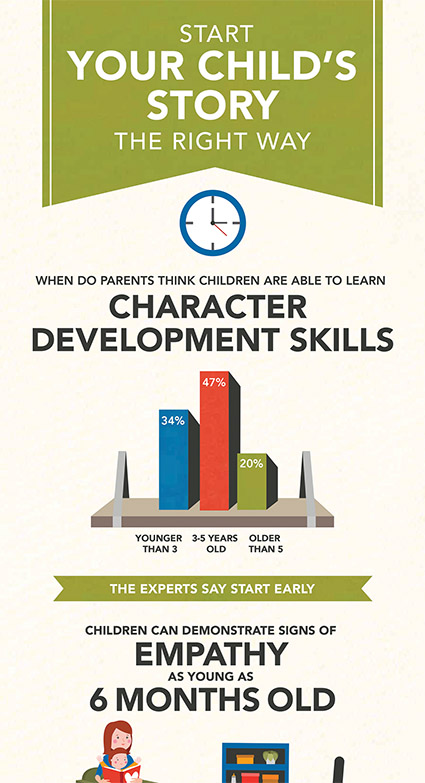

When Character-Building Should Begin


 The foundational skills for good character start emerging in the first year of life. Children as young as 6 months old can demonstrate outward signs of budding empathy skills. Character and emotional intelligence continue to develop throughout the early years and are significantly influenced by young children’s interactions with their parents and caregivers. Yet almost 50 percent of parents believe preschool is too early for children to start learning social-emotional skills, and could be missing critical opportunities to support their child’s development.

Why Nurturing Good Character Early is Important

Intentionally nurturing social-emotional skills starting at birth is an important and often overlooked opportunity as these skills have been shown to be key predictors of future health, academic and life success. Early brain and child development research now shows more clearly that the first five years of life are critical for building the foundation for traits such as honesty, generosity, compassion and kindness, which will impact children for a lifetime.

“We now know that IQ no longer represents an accurate predictor of school readiness, much less future life success,” said Dr. Laura Jana, a pediatrician and nationally acclaimed parenting and children’s book author. “It’s not just about learning the ‘3 Rs’ of reading, ’riting and ’rithmetic anymore. It’s the addition of a fourth ‘R’ that represents relationships and the importance of reading other people, which sets children up for success in today’s world.”

Finding Child Care that Nurtures Good Character


 In addition to parents, child care providers play a key role in helping children develop a strong foundation. However, more than half of parents surveyed feel their child did not or will not acquire honesty, generosity and compassion (54, 54 and 62 percent, respectively) during their early education experience.

Parents seeking early education and care for their children should look for providers that emphasize character development. In these nurturing environments, children have opportunities to learn and practice social-emotional skills every day through games, puppet play, books, music, art projects and more. At Primrose Schools, their Balanced Learning® approach also includes hands-on experiences to help children apply concepts like generosity in real-life situations.

For example, each year thousands of children at more than 325 Primrose schools across the country take part in the annual Caring and Giving Food Drive. The preschoolers earn money to purchase canned goods through chores at home. They practice perspective taking, learning about the importance of giving through stories, songs, art projects and more. They even take field trips to grocery stores to shop for food items, which are then donated to local charities. At the end of the experience, the children feel a sense of accomplishment and have practiced skills like empathy, generosity and compassion.

“We believe who children become is as important as what they know,” said Gloria Julius, Ed.D., vice president of education and professional development for Primrose Schools.

“That’s why nurturing children’s social-emotional development and building character has been an integral part of our approach for more than 30 years.”

Developing Character at Home


 Take an active approach to helping children develop a solid foundation in good character with these tips:
  • Help children recognize their feelings. Help little ones recognize and understand their feelings by giving them vocabulary words to express themselves.
  • Lead by example. Children learn a lot by watching the interactions of adults. Model social-emotional skills by listening to others, apologizing when you hurt someone’s feelings, being respectful of others, etc.
  • Help children identify other perspectives. Point out differences in other people’s thoughts and feelings. When reading with children, ask what they think the characters are feeling or narrate the emotions and exaggerate facial expressions for young children.
  • Talk about your own decisions in terms of right and wrong. As children’s abilities and understanding grows, discuss your values and take advantage of everyday situations to describe and demonstrate good citizenship and desirable behavior.
  • Let kindness and respect rule the day. Set household guidelines grounded in showing kindness and respect, and help children learn to follow them. When they break the rules, calmly explain how or why their behavior was unkind and how they could have better handled the situation.
For additional information, tips and resources on how to nurture good character in children, visit PrimroseSchools.com/character-resources.
SOURCE:
Primrose Schools

5 Ways to Persuade a Picky Eater


Section Image

(Family Features) For parents with a picky eater, it may seem that no amount of coaxing or prodding will get that little mouth in motion. A fresh approach may be all you need to make meal time a more enjoyable experience for all.

Proper nourishment is essential for a child’s development, so when a battle of wills erupts over food, it can leave parents feeling especially frustrated and concerned about their child’s well-being.

Fortunately, there are several strategies you can adapt to get meal time on track and healthy eating habits underway.

Make a one-bite rule.
A simple fact is that not everyone likes everything when it comes to food. Allow your child a sense of control in making decisions about the foods he or she likes or dislikes. When offering new items, implement a rule that requires trying at least one bite. Then, if he or she declines more, set it aside and focus on the other foods you are offering. Remember, tastes change over time – even day to day for some kids – so don’t be afraid to try again in the future.
]

Offer a fun incentive.
Make meal time an interactive experience with tableware that makes eating fun. Dinner Winner, by specialty giftware company Fred, is an award-winning kid’s dinner tray divided into small sections like a board game, where parents can portion out food into manageable bites along the path. The goal is to get to the finish line where a special covered treat awaits, providing motivation for children to eat their entire meal. The food-safe and dishwasher-safe plate is available in four styles – Original, Pirates, Supper Hero and Enchanted Forest – and features encouraging phrases like “keep it up” and “almost there.”

Keep it simple.
In an effort to entice kids to eat, some well-intentioned parents offer too many choices, which can be overwhelming. Instead, limit the options and let them pick from two meal options, such as a turkey sandwich or a peanut butter and jelly.

Approach meals like building blocks.
Think of each meal as a tower of blocks you’re teaching your child to stack. The bottom piece, the sturdy foundation, is a familiar food he or she willingly accepts like chicken or noodles. Then layer on additional pieces, such as adding a sauce with pureed veggies or a new protein.

Create a sense of ownership.
Kids are more likely to eat when they can take pride in the fruits of their labor. Enlist their help picking recipes and selecting foods at the grocery store, and encourage them to help make the foods they selected. Much like prized hand-made artwork, children enjoy showing and sharing the things they make all by themselves.

Find more kid-friendly solutions for mealtime and beyond at fredandfriends.com.
Photo courtesy of Jen Anderson (boy eating dinner)
Photo courtesy of Fred® (dinner plate)
SOURCE:
Dinner Winner

Keeping Kids Active in Cooler Temperatures


Section Image

(Family Features) As the weather gets colder, it can be harder to motivate kids to step away from their computers and devices and get off the couch. However, it’s essential for kids to participate in active play all year round. According to research from the Centers for Disease Control and Prevention, regular physical activity helps build and maintain healthy bones and muscles, promotes psychological well-being and reduces feelings of depression and anxiety.

Sadly, physical activity is becoming less of a priority in kids’ daily routines. A recent survey conducted by Let’s Play, an initiative from Dr Pepper Snapple Group to make active play a daily priority, found that 64 percent of parents said busy schedules stand in the way of more active play for their children, up from 56 percent in 2015.

Each season brings its own opportunities for play, and fall is no exception. Families can beat the cold weather blues and stay active together by trying some of the following activities:

Plan a nature walk to find inspiration and materials for art.
Even though it’s chilly outside, your family can still get out and enjoy the outdoors. Bundle up and take a nature hike with your kids around the neighborhood or at a local, national or state park. Encourage your kids to collect items like pinecones, acorns and leaves as you go and to be on the lookout for wildlife to observe. After the hike, take out art and craft supplies and help them create projects with the items they found.

Plan an indoor scavenger hunt.
When a really cold day comes along, send your kids on a fun and active scavenger hunt around the house, searching for items that you can hide in advance. Work together as a family to locate the items or create some friendly family competition to see who can find all the items first. Having the family move around the house with a mission prevents the temptation of staying on the couch in front of the television all day.

Join a class or indoor sports team.
Whether you are playing a favorite sport or learning a new one, it is always more fun with other people. Longer stretches of active play are often more likely to occur with friends or siblings. Sign your children up for an indoor sport or class they have never tried before, such as gymnastics, rock climbing, swimming or dance. This allows your children to learn something new, meet kids their age and be active for an extended period of time.

Volunteer.
While giving back is always in season, this time of year is a perfect opportunity to teach kids about giving back to those in need and being grateful for what they have. Sign the whole family up to volunteer at a local soup kitchen, participate in a toy drive for a children’s hospital or help out at an animal rescue shelter. Your children will not only be active, but will also grow emotionally, socially and intellectually as a result.

For more tips on how to keep kids active and to find play inspiration for all seasons, visit LetsPlay.com.

Photo courtesy of Getty Images
SOURCE:
Dr Pepper Snapple Group

Paying for college: Options reduce need for student loans

(BPT) - While only a fortunate few students can expect a free college education by winning full academic or athletic scholarships, everyone can take advantage of a combination of academic aid, grants, fellowships, work-study and student loans to pay for a four-year degree, says Peter Gayle, a vice president for Prudential Advisors. Unfortunately, many prospective students and their families often don’t know where to look.

With student debt increasingly becoming a long-term burden on graduates and families, adds Gayle, it’s never been more important to minimize the out-of-pocket expenses to put a student through college — and reduce reliance on student loans.

To put the weight of student debt in perspective, The Federal Reserve Bank of New York noted that in 1995, 54 percent of graduates had loans averaging $11,491. It’s more recent data in 2015 showed 71 percent of graduates joined the workforce with student debt averaging slightly more than $35,000. What’s more, the Federal Reserve Bank of New York estimates 25 percent of those who owe federal student loans are delinquent or in default.

The good news is that anyone willing to put in the time can likely find programs that help foot the bill — helping to reduce the need to take out loans — so a student’s education won’t break the budget or jeopardize a financial future. According to Gayle, families can take a few initial steps before choosing a school:

* Learn how the financial aid process works and get the most out of options that don’t need to be repaid.
* Understand each school’s actual net price — after financial aid — and set realistic expectations, choosing from the most affordable institutions.
* Explore types of financial aid, including grants, work study programs and scholarships; examine the specific types of aid available per school and find out how much of a family’s demonstrated financial need each school will cover.
* Understand the kinds of loans available, including a variety of federal loans and private loans, which may be used to fill any financing gaps after exhausting other options.
* Understand how parents’ “available income” is used to calculate how much parents are expected to contribute to their child’s education, especially for federal financial aid purposes.

Several guides, including Prudential Financial’s www.prudential.com/payingforcollege, can help families take a carefully considered approach to financing a college education while safeguarding a student’s long-term financial future, including the ability to save for retirement.

For families that must use student loans, the federal government is making it easier to understand how to borrow, process applications and repay loans through new online tools. Since 2010, all new federal loans, except Federal Perkins Loans, have been issued through the U.S. Department of Education, which offers information about borrowing and repaying loans.

There are multiple options to repay federally funded student loans, which generally require repayments to start six or nine months after a student graduates, leaves school or drops to half-time enrollment. A few popular choices for repayment include types of income-driven plans, which calculate payments based on a borrower’s ability to repay. One catch: It’s critical to re-certify income and family size annually to avoid huge monthly payment increases.

When debt becomes too burdensome, some loan programs offer forgiveness through public service, federal government employment, and options like teaching in underserved school districts.

Private loans are trickier since there is no standard: Interest rates and repayment terms vary from lender to lender. It’s also worth considering the need for life insurance to cover the full loan balance to aid co-signers or beneficiaries in the event of the borrower's death, says Gayle. Financial advisors would be well-equipped to help explore this and other options, Gayle notes.

Employers are also beginning to offer employee student debt benefits to put their employees on a course for financial security. At Prudential Financial, for example, new employees hired through the company’s campus recruitment program beginning in January 2017 could earn an incentive of up to $5,000 toward paying off student loans after one year of service. Other companies match student debt payments with contributions to employee retirement savings plans.

Studies show college education can be worth the price. The U.S. Census Bureau estimates that students who attend college can earn nearly twice as much over their lifetimes as those with only a high school diploma. But with college tuitions continuing to rise, families must find the most effective way to finance a child’s college education to avoid jeopardizing their ability to save for retirement.

"Prudential Advisors" is a brand name of The Prudential Insurance Company of America and its subsidiaries located in Newark, NJ.

0300462-00001-00

Cyberattack 411: Protecting your vehicle from hackers

(BPT) - New vehicles are packed full of the latest and greatest technology. Among their many capabilities, today’s vehicles can automatically apply brakes to avoid collisions, maintain a designated following distance behind the car ahead of it and maneuver the vehicle back into its lane if the driver veers out of it. Some cars can even drive and park themselves!

Additionally, in-car Wi-Fi and mobile hotspots allow passengers to connect their computers, tablets and smartphones to the internet from the convenience of the vehicle cabin. Bluetooth allows hands-free use of phones, and infotainment systems let people enjoy their favorite tunes, access apps, navigate and more.


These technological advances provide tremendous benefits for drivers and passengers, but much of this technology can also be used to launch cyberattacks on your vehicle.


“Modern cars are essentially rolling computers and, just as your laptop, smartphone or tablet can be hacked, so can these driving machines,” says Craig Smith, author of The Car Hacker’s Handbook and founder of the Open Garages vehicle research lab.


Millions of today’s vehicles possess vulnerabilities that leave them open to new age methods of theft that don’t require a key or Slim Jim or, worse, situations where drivers no longer have control over their vehicles while driving. Mercury Insurance, one of the nation’s leading auto insurance providers, recently connected with Smith to help keep drivers safe and shed some light on this growing problem.

According to Smith, there are several key vulnerable areas consumers should be aware of, including:

* On-board diagnostics-II (OBD-II) ports;

* Key fobs;
* Infotainment systems (including audio files that owners may have synced for in-car entertainment);
* In-car Wi-Fi;
* Mobile hotspots;
* Navigation systems;
* Smartphones (connected to cars via Bluetooth); and
* Tire pressure monitoring systems.

“There are many factors that go into determining a vehicle’s risk of being hacked,” says Smith, who has worked in the security industry for more than 20 years and with the auto industry for five. “Newer vehicles have what we call a higher ‘attack surface,’ meaning there are more areas that are hackable."


“If you are specifically concerned about remote hackers, as opposed to those who have physical access to your car, then look at the wireless systems your vehicle supports. If your vehicle has telematics, satellite or digital radio, internet, Bluetooth, or wireless key fobs, these wireless services can provide entry points for an attacker over varied distances. This is also true for aftermarket components added to your vehicles, such as dongles plugged into your vehicle to monitor your driving for insurance reasons.”


Local hackers can gain access to a car to unlock it and steal its contents or even start the ignition to steal the vehicle.


To protect against vehicle hacking, Smith recommends disabling wireless services that aren’t being used. Consumers should refer to the information their auto manufacturer provides on vehicle features, decide which ones are important and only enable those options. Those who wish to use a dongle in their vehicle should try to use it sparingly and take it with them when they leave their car.


“The key to protecting your vehicle if it’s deemed at-risk for hacking is to disable the components that have the most risk. For instance, if the radio unit is the culprit you can disable it or replace it,” says Smith. “And while newer vehicles tend to have a larger attack surface, they also have more safety features that can help minimize or avoid injury in a collision, so you should consider that as well.”


Mercury Insurance is helping consumers answer the question “How Hackable is Your Car?” with an infographic that shows the areas of a consumer’s specific vehicle that may be vulnerable to a cyberattack. Visit https://blog.mercuryinsurance.com/how-hackable-is-your-car to learn more.


“We continuously review the automotive marketplace, so we can provide consumers with important information about how to protect themselves, families and property, whether it’s about the dangers of distracted driving, teen driving safety or, now, vehicle hacking,” says Tom Coyne, auto line lead for Mercury Insurance. “And Mercury doesn’t use dongle technology because we don’t want to increase our customers’ risk of a cyberattack, which we think they appreciate.”

Polls Show Personal Experience With Obamacare Increases Opposition

As Congress comes closer to repealing Obamacare, proponents of the law have mounted a vocal defense of it, touting both its necessity and popularity among those it has helped.

But public opinion polls tell a different story.

Obamacare was passed in 2010 amid controversy, and has not done very well since. Because some of its provisions polled well, many expected that as the law was implemented over time it would become more popular, similar to Social Security and Medicare.

The Atlantic, for instance, reported on Oct. 10, 2013 that a poll of Democratic political insiders showed that 98 percent thought Obamacare would become more popular once it was implemented.

Similar sentiments were expressed by Sen. Charles Schumer, D-N.Y., on “Meet the Press” on Mar. 28, 2010, just days after the law was signed by President Barack Obama:

I think as people learn about the bill, and now that the bill is enacted, it’s going to become more and more popular … So I predict, by November those who voted for health care will find it an asset, those who voted against it will find it a liability.

Yet despite recurring optimistic predictions, Obamacare has remained persistently unpopular. Disapproval of the law has consistently outweighed approval, sometimes by margins as large as 20 points.

The polling data show us that Obamacare has been unpopular. They can also shed light on why.

The Pew Research Center finds that as time goes on, more people report being personally affected by Obamacare—as would be expected for any new government program.

However, Americans reporting they have been negatively affected is higher than those who say they have been positively affected.

Similarly, Gallup’s regular polling also consistently found that more Americans said the law has hurt them and their families than say it has helped, sometimes by a margin of 2-to-1.

Over the second half of 2016, that margin widened. Twenty-nine percent of Americans said they had been hurt by it, an increase from 26 percent earlier in the year. Only 18 percent said they had been helped, down from 22 percent, for a full 11-point margin.

In comparison, when Pew asked about “the health care law’s effect on you and your family,” negative responses outweighed positive responses 31 percent to 23 percent—a 9-point margin.

Quality of care, access, and soaring costs usually top the list of issues and concerns Americans have with Obamacare.

According to another study by Gallup, those rating their health care coverage as excellent decreased 5 points in 2015 from 30 percent to 25 percent, while those who rated their coverage “only fair” climbed.  Those rating the quality of health care they receive as excellent dropped 8 points over the same time period, from 39 percent to 31 percent.

Those paying some or all of their health premiums increasingly say their premiums have gone up (74 percent in 2015, up from 67 percent in 2014).

Despite promises that Obamacare would help make health care more affordable, 67 percent of Americans in a Kaiser Health Tracking Poll conducted in December 2016 still say lowering the cost of health care should be a top priority for President Donald Trump and Congress.

In short, as more Americans personally experienced Obamacare, more of them expressed dissatisfaction with its results. That strengthens the Republicans’ case for repealing and replacing the law.

Commentary by The Heritage Foundation's Elizabeth Fender.  Originally published at The Daily Signal.

Don’t Let the Democrats Fool You About a 60-Vote Threshold for Neil Gorsuch

This week, I had the pleasure of being at the White House when President Donald Trump introduced his nominee to be associate justice of the Supreme Court, Judge Neil Gorsuch of the 10th U.S. Circuit Court of Appeals.

It shouldn’t surprise anybody that the president delivered on a promise made during the campaign when he listed 21 people that he would choose from. Everybody knew ahead of time what sort of a judge he would put on the court for this vacancy or any future vacancy.

Gorsuch’s decade of service on the 10th Circuit has earned him a reputation as a brilliant, principled, and mainstream judge. It’s already been widely reported that he was unanimously confirmed by a voice vote to the 10th Circuit. There are still 31 senators in this body who voted for the judge at that particular time. Twelve of them are Democrats, and one of them is Senate Minority Leader Chuck Schumer of New York.

Yet even before we had the nominee, there were some Democrat members who vowed to filibuster the nominee, sight unseen. That’s, of course, unfortunate. But given how Democrats have treated the president’s Cabinet nominees so far, it isn’t exactly surprising.

Gorsuch is universally respected as one of the finest and most fair-minded judges in our country. In fact, one of President Barack Obama’s solicitors general called him “one of the most thoughtful and brilliant judges to have served our nation over the last century.” If that’s not “mainstream,” I don’t know what is.

After the president’s announcement, something interesting happened. Right out of the gate, there were a number of Senate Democrats calling for “a hearing and a vote.” Well, that certainly sounds encouraging. The press picked up on these comments, and one newspaper even reported that after learning who the nominee was, there were already seven Senate Democrats opposed to filibustering him.

At first glance, it appears those Democrats were trying to be consistent with their stance from last year that a nominee deserves a hearing and an up-or-down vote. That’s what those comments would lead you to believe. Even the press was fooled.

But of course, now they conveniently seem to have dropped the “up-or-down” portion of that stance.

That’s a neat trick.

Take for example, one of my colleagues who just last year said, “The Constitution says the Senate shall advise and consent, and that means having an up-or-down vote.” But, oddly, just yesterday, that same colleague said, “I support a 60-vote margin for all Supreme Court nominees.”

That’s a nice sleight of hand. But most senators aren’t that gullible.

The Washington Post fact-checker certainly took notice of their wordsmithing. And that has earned them two Pinocchios. When you look at the facts, a 60-vote threshold has never been the “standard” as the Democrat leader said yesterday. Otherwise, we wouldn’t have two of the current justices sitting on the Supreme Court.

My colleagues tried unsuccessfully to filibuster Justice Samuel Alito. The Senate voted 72-25 to invoke cloture. He was then confirmed 58-42 on an “up-or-down” vote. Justice Clarence Thomas was confirmed 52-48. There was no cloture vote on his nomination.

In fact, the Senate didn’t set any sort of requirement that there be 60 votes for seven of the eight justices serving on the court. So if there has been any sort of requirement or practice in the Senate on Supreme Court nominees, it’s that the nominee does NOT have to get 60 votes, although many of them end up getting that kind of support.

We already know some members have pledged to filibuster the nominee. And the Democrat leader stated that part of the “fair process” is a 60-vote threshold. I suppose if you’re already committed to attempting a filibuster on a Supreme Court nominee before you even know who it is, then you might consider that part of the “fair process.”

Of course, we all know—Republicans and Democrats—that launching a filibuster against a Supreme Court nominee isn’t part of a “fair process.” It never has been.

But I suppose we should cut our colleagues a little slack. They’re having a hard time figuring out how to make good on their promise to attack the nominee no matter who it is, when they’ve now been presented with a nominee with impeccable credentials and broad, bipartisan support.

And this brings me to my second point.

Gorsuch had barely finished speaking at the White House, and there were already attacks on the nominee by some on the left. Some of my colleagues on the other side of the aisle have already taken to the Senate floor to attack and mischaracterize Gorsuch’s record.

Though we expected it, these scurrilous attacks are untoward and misplaced.

After all, those on the left trot out the same tired arguments against every Republican nominee.

They attacked Justice John Paul Stevens because he “revealed an extraordinary lack of sensitivity to the problems women face.” They called Justice Anthony Kennedy a “sexist” who “would be a disaster for women.” And they said there was “ample reason to fear” Justice David Souter.

This morning, The Washington Post editorial board noted that while we argued last year that the president shouldn’t fill a Supreme Court vacancy that occurs during a presidential election year, Senate Republicans “refrained from tarring Mr. [Merrick] Garland personally.”

In contrast, they noted that “trashing Mr. Gorsuch as an outlandish radical, despite his impeccable credentials, the wide respect he commands in his field, his long service as an appeals court judge and the unanimous voice vote he received the last time the Senate considered him for the federal bench, is at the very least premature.” Our friends on the other side of the aisle would do well to take note of this observation.

If the process we’ve witnessed for Trump’s Cabinet nominees is any guide, I’m quite confident we’ll hear all manner of reasons and arguments about why we should delay a hearing for Gorsuch.

But, as my friend and former chairman of the Judiciary Committee, Sen. Patrick Leahy, often notes: Supreme Court nominees don’t have the opportunity to respond to personal attacks outside of their confirmation hearing.

I’m going to consult with Sen. Dianne Feinstein, D-Calif., ranking member on the Judiciary Committee, about the timing for Gorsuch’s hearing. But I can tell you what we aren’t going to do. We’re not going to delay this hearing, especially in the face of all of these attacks on his record and character.

I met with Gorsuch yesterday. He’s as impressive in person as he is on paper.

I expect that as my friends on the other side of the aisle meet Gorsuch and actually review his record, they’ll find him to be an eminently qualified and universally respected judge whose decisions faithfully applying the text of the law place him well within the judicial mainstream.

Commentary by Senator Chuck Grassley.  Originally published at The Daily Signal.

Americans Should Not Have to Subsidize Campus Lawlessness

In 1964, students at the University of California, Berkeley joined together to fight for their right to free speech.

Last night, a group of over 1,500 protestors showed up on that same campus to shut down a speaker with whom they disagreed, and about 150 of them started a riot.

Clearly, the culture of tolerance on college campuses has changed quite a bit since 1964.

Last night, Breitbart News editor Milo Yiannopoulos stopped by the UC Berkeley campus on his college tour to talk about the importance of free speech, yet was met with shocking hostility that led to violence.

He is well known for criticizing the “social justice left” in a very provocative manner that elicits a strong response from the campuses he visits. He is no stranger to disruptive protests outside his events.

However, the new violent nature of these protests prompts a discussion over whether or not the school should be a recipient of federal funds.

Videos have surfaced of a crowd of protestors beating a man unconscious and lighting a massive fire, which led to the cancellation of Yiannopoulos’ speaking engagement by the university.

Yet as of last night, campus police remained minimally involved in containing the riots, with the police chief saying she was not aware of any arrests made.

This soft response seems odd in light of UC Berkeley’s statement this morning, which affirmed the importance of free speech:

Campus officials [said] that they regret that the threats and unlawful actions of a few have interfered with the exercise of First Amendment rights on a campus that is proud of its history and legacy as the home of the Free Speech Movement.

If UC Berkeley is so dedicated to protecting Yiannopoulos’ free speech, why the weak response?

The riots were violent enough to elicit a response from President Donald Trump, who tweeted out, “If U.C. Berkeley does not allow free speech and practices violence on innocent people with a different point of view – NO FEDERAL FUNDS?”

Indeed, American taxpayers should be well aware of where their money is going.

UC Berkeley is a public institution that receives federal dollars, yet it appears to allow violence, censorship, and holds contempt for the Constitution and the rule of law.

UC Berkeley is a public institution that receives federal dollars.

Yet on Jan. 26, the university’s chancellor issued a statement saying that Yiannopoulos had “been widely and rightly condemned for engaging in hate speech” and added that “Mr. Yiannopoulos’s opinions and behavior can elicit strong reactions and his attacks can be extremely hurtful and disturbing.”

Hardly impartial statements.

This is not the first time lawmakers have called for federal funds to be withheld from Berkeley, California.

In 2008, Heritage Foundation President and former Sen. Jim DeMint called for federal funding to be revoked from the city after the Berkeley City Council voted to remove a Marine Corps recruiting center from the city.

As DeMint said, “The First Amendment gives the city of Berkeley the right to be idiotic, but from now on they should do it with their own money.”

No city and no university campus should turn a blind eye to the rule of law in order to promote their political agendas. Indeed, the acceptance of federal funds should require an adherence to the basic rights guaranteed Americans in the Constitution—and that includes the First Amendment.

The threats to freedom of speech on college campuses are disturbing and warrant a response.

On Tuesday, Stanley Kurtz along with Jim Manley and Jonathan Butcher of the Goldwater Institute presented model state legislation at The Heritage Foundation to combat censorship and restriction of free speech on college campuses, which is intended to silence any dissenting views on political and social issues.

If adopted, this state-level legislation would require universities to open their doors to all invited speakers and reaffirm their commitment to free speech.

This is an important first step in restoring respect for constitutional rights in our university systems, something that is essential to preserving the free flow and vigorous debate of ideas that is fundamental to thriving academic institutions.

On the federal level, lawmakers should consider policies that limit federal subsidies to institutions that are hostile to free speech and who allow violence, threats, and intimidation of speakers and students to occur without consequence.

Taxpayers, who are already on the hook for $1.3 trillion in outstanding student loan debt should not continue to provide funding for universities that do not offer First Amendment protections to their students and guests.

Hopefully, such legislative responses will restore our universities to being places of thoughtful debate, where opposing views are met with respect and civil debate, rather than riots.

The Myth of the Bee-pocalypse

You’ve probably heard by now that bees are mysteriously dying. In 2006, commercial beekeepers began to witness unusually high rates of honeybee die-offs over the winter — increasing from an average of 15 percent to more than 30 percent. Everything from genetically modified crops to pesticides (even cell phones) has been blamed. The phenomenon was soon given a name: colony collapse disorder.

Ever since, the media has warned us of a “beemaggedon” or “beepocalypse” posing a “threat to our food supply.” By 2013, NPR declared that bee declines may cause “a crisis point for crops,” and the cover of Time magazine foretold of a “world without bees.” This spring, there was more bad news. Beekeepers reported losing 42.1 percent of their colonies over the last year, prompting more worrisome headlines.

Based on such reports, you might believe that honeybees are nearly gone by now. And because honeybees are such an important pollinator — they reportedly add $15 billion in value to crops and are responsible for pollinating a third of what we eat — the economic consequences must be significant.

Riding the buzz over dying bees, the Obama administration announced the creation of a pollinator-health task force to develop a “federal strategy” to promote honeybees and other pollinators. The task force unveiled its long-awaited plan, the National Strategy to Promote the Health of Honey Bees and Other Pollinators. The plan aims to reduce honeybee-colony losses to “sustainable” levels and create 7 million acres of pollinator-friendly habitat. It also calls for more than $82 million in federal funding to address pollinator health.

But here’s something you probably haven’t heard: there are more honeybee colonies in the United States today than there were when colony collapse disorder began in 2006. In fact, according to data released in March by the Department of Agriculture, U.S. honeybee-colony numbers are now at a 20-year high. And those colonies are producing plenty of honey: U.S. honey production is also at a 10-year high.


Almost no one has reported this, but it’s true. You can browse the USDA reports yourself. Since colony collapse disorder began in 2006, there has been virtually no detectable effect on the total number of honeybee colonies in the United States. Nor has there been any significant impact on food prices or production.

How can this be? In short, commercial beekeepers have adapted to higher winter honeybee losses by actively rebuilding their colonies. This is often done by splitting healthy colonies into multiple hives and purchasing new queen bees to rebuild the lost hives. Beekeepers purchase queen bees through the mail from commercial breeders for as little as $15 to $25 and can produce new broods rather quickly. Other approaches include buying packaged bees (about $55 for 12,000 worker bees and a fertilized queen) or replacing the queen to improve the health of the hive. By doing so, beekeepers are maintaining healthy and productive colonies — all part of a robust and extensive market for pollination services.

Economists Randal Rucker and Walter Thurman have carefully documented how these pollination markets work and how they respond to problems like bee disease. As it turns out, they work pretty well. A 2012 analysis by Rucker and Thurman found almost no economic impact from colony collapse disorder. (If anything, you might be paying 2.8 cents more for a can of Smokehouse Almonds.) They conclude that beekeepers are “savvy entrepreneurs” who have proven able to “adapt quickly to changing market conditions” with almost no impact on consumers.


What about beekeepers themselves? Rebuilding lost colonies takes extra work, but so far most beekeepers seem adept at doing so. Rucker and Thurman find that the prices for new queen bees have remained stable, even with increased demand due to higher winter losses. Pollination fees, the fees beekeepers charge farmers to provide pollination services, have increased for some crops such as almonds. But these higher pollination fees have helped beekeepers offset the additional costs of rebuilding their hives.

The White House downplays these extensive markets for pollination services. The task force makes no mention of the remarkable resilience of beekeepers. Instead, we’re told the government will address the crisis with an “all hands on deck” approach, by planting pollinator-friendly landscaping, expanding public education and outreach, and supporting more research on bee disease and potential environmental stressors. (To the disappointment of many environmental groups, the plan stops short of banning neonicotinoids, a type of pesticide some believe are contributing to bee deaths.)

This is not to deny that beekeeping faces challenges. Today, most experts believe there is no one single culprit for honeybee losses, but rather a multitude of factors. Modern agricultural practices can create stress for honeybees. Commercial beekeepers transport their colonies across the country each year to pollinate a variety of fruits, vegetables, and nuts. This can weaken honeybees and increase their susceptibility to diseases and parasites.

But this is not the first time beekeepers have dealt with bee disease, and they do not stand idly by in the face of such challenges. The Varroa mite, a blood-sucking bee parasite introduced in 1987, has been especially troublesome. Yet beekeepers have proven resilient.

Somehow, without a national strategy to help them, beekeepers have maintained their colonies and continued to provide the pollination services our modern agricultural system demands.

“What are we doing on bees?” the president reportedly asked his advisers in 2013. “Are we doing enough?” With U.S. honeybee colonies now at a 20-year high, you have to wonder: is our national pollination strategy a solution in search of a crisis?

This piece originally appeared at National Review via Perc
Shawn Regan
Shawn Regan
Shawn Regan is the Director of Publications and a Research Fellow at PERC. He holds a M.S. in Applied Economics from Montana State University and degrees in economics and environmental science from Berry College. His work has appeared in the Wall Street JournalQuartzHigh Country News,ReasonRegulationGrist, and Distinctly Montana. Shawn is also a former backcountry ranger for the National Park Service.

This article was originally published on FEE.org. Read the original article.

Ayn Rand's Heroic Life

I first encountered Ayn Rand through her nonfiction. This was when I was a junior in high school, and I'm pretty sure it was my first big encounter with big ideas. It changed me. Like millions of others who read her, I developed a consciousness that what I thought – the ideas I held in my mind – mattered for what kind of life I would live. And it mattered for everyone else too; the kind of world we live in is an extension of what we believe about what life can mean. 

People today argue over her legacy and influence – taking apart the finer points of her ethics, metaphysics, epistemology. This is all fine but it can be a distraction from her larger message about the moral integrity and creative capacity of the individual human mind. In so many ways, it was this vision that gave the postwar freedom movement what it needed most: a driving moral passion to win. This, more than any technical achievements in economic theory or didactic rightness over public-policy solutions, is what gave the movement the will to overcome the odds.

Often I hear people offer a caveat about Rand. Her works are good. Her life, not so good. Probably this impression comes from public curiosity about various personal foibles and issues that became the subject of gossip, as well as the extreme factionalism that afflicted the movement she inspired.

This is far too narrow a view. In fact, she lived a remarkably heroic life. Had she acquiesced to the life fate seemed to have chosen for her, she would have died young, poor, and forgotten. Instead, she had the determination to live free. She left Russia, immigrated to the United States, made her way to Hollywood, and worked and worked until she built a real career. This one woman – with no advantages and plenty of disadvantages – on her own became one of the most influential minds of this twentieth century.

So, yes, her life deserves to be known and celebrated. Few of us today face anything like the barriers she faced. She overcame them and achieved greatness. Let her inspire you too.

Kudos to the Atlas Society for this video:

Jeffrey Tucker
Jeffrey Tucker
Jeffrey Tucker is Director of Content for the Foundation for Economic Education. He is also Chief Liberty Officer and founder of Liberty.me, Distinguished Honorary Member of Mises Brazil, research fellow at the Acton Institute, policy adviser of the Heartland Institute, founder of the CryptoCurrency Conference, member of the editorial board of the Molinari Review, an advisor to the blockchain application builder Factom, and author of five books. He has written 150 introductions to books and many thousands of articles appearing in the scholarly and popular press.
This article was originally published on FEE.org. Read the original article.

Study Refutes Link Between Strokes, Chiropractic Care

(NewsUSA) - Is it time to finally put this one to rest?

Every once in a while, when some high-profile young man or woman dies unexpectedly from a stroke, the media races to find an explanation. Aha! She ran a marathon without being in shape! Aha! He visited a chiropractor several days before to relieve a pinched nerve in his neck!

The latter theory at least is refuted by research done this year by a team of neurosurgeons at the Penn State Hershey Medical Center. They performed what they described as "a systematic review and meta-analysis of published data" to determine whether there's a direct correlation between the manipulation performed by doctors of chiropractic -- manual adjustments widely acknowledged to relieve muscle-related pain -- and a condition called cervical artery dissection (CAD) in which a small tear opens in the artery walls of the neck.

That's important since such a tear can result in a stroke should a blood clot form and later break free to block a blood vessel in the brain.

The team's conclusion? "There is no convincing evidence to support a causal link between chiropractic manipulation and CAD."

CAD is actually quite rare. It's been estimated that it annually strikes only two to three people, per 100,000 of the population, and various epidemiologic studies through the years suggest that strokes can occur at an equal rate whether sufferers are under chiropractic or other medical care for the headaches and neck pain it often produces.

As for chiropractic care in general, it's worth remembering that -- after the Centers for Disease Control and Prevention urged doctors last March to avoid prescribing potentially addictive prescription painkillers in the face of mounting deaths -- a slew of health experts joined the chorus of those who'd already been praising chiropractic as a safe and effective treatment for neck, mid back, and lower back pain.

"Not only is chiropractic care very safe, it actually poses fewer risks than medical or surgical treatment," says Gerard Clum, DC, a spokesperson for the not-for-profit Foundation for Chiropractic Progress.

New Obamacare Report Shows Rising Costs and Fewer Options for 2017

A new report shows that Obamacare enrollees could pay more money and end up with fewer options in 2017.

The study from Avalere Health, a health care consulting firm, showed rising premiums, deductibles, and out-of-pocket costs for many customers, a shrinking amount of insurance options in the insurance exchange market, and a drastically lower number of Obamacare enrollees than projected.

Premiums for the silver-level plan, Obamacare’s most popular option, increased by an average of 12 percent in 2017. Specifically, the Avalere report showed that 71 percent of Obamacare enrollees covered under the silver plan have seen their average costs rise from $496 per month last year to $554 per month this year. The average cost for the first and second cheapest silver-level plans have also gone up by 25 percent.

Even for Obamacare’s bronze-level plan — the cheapest, lowest quality option — the monthly, average premiums rose from $408 in 2016 to $475 this year.

“Part of the reason why these premiums are rising is because there are fewer people enrolled than I expected, and the people who are enrolled are sicker than expected,” said Chris Sloan, a senior manager at Avalere, in a phone interview with The Daily Signal.

However, according to Sloan, with government subsidies and tax credits, lower-income earners enrolled in Obamacare may not be affected by the rising costs of these cheaper plans.

“While many consumers will experience significant premium increases this year, most will receive subsidies to help offset the costs of the increases and make premiums more affordable,” Sloan said in a statement.

Obamacare premiums are going up, but due to government financial assistance, real costs for many enrollees is remaining relatively the same. This cost will fall on taxpayers, according to a health care expert.

“If subsidies are going up through premium tax credits and cautionary reduction subsidies, the federal taxpayer ends up paying for that increase, so the burden of that is on all us federal taxpayers,” said Alyene Senger, a health care policy analyst at The Heritage Foundation.

Senger added, “When supporters of the [Affordable Care Act] say, ‘well, these figures don’t really matter, because we’re subsidising [Obamacare enrollees] so they aren’t feeling the brunt of their premium increases because the federal taxpayer is picking up the tab,’ that doesn’t apply to all the people who are purchasing in the individual market that get no subsidy.”

However, even with many Obamacare enrollees being assisted by subsidies or tax credits, they may still find themselves paying more out-of-pocket for their health care, as deductibles for services and drugs jumped by about 20 percent for silver-level plans in 2017. The number of silver-level plans charged coinsurance — an out-of-pocket payment charged after a consumer’s deductible is paid — for specialty drugs went up by 10 percent.

Issuer participation is also a problem highlighted by the Avalere report, as approximately one-in-three regions in America now only have one health insurance issuer. In 2016, just four percent of the country was limited to one issuer in their region. After several national and regional insurers exited the exchange markets, 36 percent of the country is now stuck with one issuer in their region.

“What this means is that people who have purchased insurance for 2017 have a lot less choice, so if there’s only one issuer offering health plans in your area and their network doesn’t include your doctor, then that’s it, you don’t really have another option,” Sloan told The Daily Signal.

“People in this market just won’t have as much choice as they had in 2016, or 2015, or 2014,” Sloan said.

This Avalere report, titled “2017 Health Insurance Exchange Snapshot,” was published on Jan 18.

Report by The Daily Signal's Caleb Escarma.  Originally published at The Daily Signal.

Nebraska Woman Loses Health Insurance for Fourth Time Under Obamacare

Pamela Weldin of Minatare, Nebraska, lost her insurance four times since the Affordable Care Act took effect in 2014. (Photo: Pamela Weldin)

Pamela Weldin’s experiences with Obamacare can be boiled down to just a few numbers.

Since the health care law’s implementation three years ago, Weldin, 60, has lost her insurance four different times.

And the Nebraska woman is currently enrolled in her fifth new insurance policy in four years.

“Yet again, and through no fault of my own,” Weldin told The Daily Signal. “I’m just sitting here minding my own business, and here we go again.”

A former dental hygienist, Weldin has all the hallmarks of a consumer intended to benefit from the Affordable Care Act.

She has been denied coverage in the past because of a pre-existing condition related to her career as a dental hygienist.

Additionally, Weldin qualifies for a tax credit, which she has received every year since 2014.

As a result, her premiums are low when compared to consumers who don’t qualify for financial assistance: In early 2015, Weldin purchased a plan through Blue Cross and Blue Shield of Nebraska that cost her $232 each month.

This year, premiums for her silver-level plan with Medica are $161 per month after her tax credit. Without the financial assistance, her premiums would total more than $1,300 per month.

But though Weldin has benefited from aspects of the law, she hasn’t been immune to the changes in the health insurance market that have occurred in last few years.

“I’m a person who has been denied because of pre-existing conditions,” Weldin, a Pampered Chef director, said. “I’m on Obamacare and have lost my insurance four times in three years. I understand the challenges, but it’s not sustainable.”

Weldin’s Journey

Since HealthCare.gov opened for business in the fall of 2013, four policies sold by three different insurance companies—Humana, CoOportunity Health, and Blue Cross and Blue Shield of Nebraska—that Weldin purchased were ultimately terminated.

The Daily Signal previously covered her experiences with Obamacare in a February 2015 article.

But since then—when Weldin lost her insurance for a third time—she’s logged another cancellation.

First, Weldin’s initial policy with Humana, which she held for several years, was canceled in the lead-up to Obamacare’s implementation in January 2014.

The Nebraska woman then purchased a platinum-level plan for 2014 through CoOportunity Health, a consumer operated and oriented plan, or co-op. But CoOportunity Health terminated her platinum-level policy for 2015 after the co-op decided it would no longer offer those policies.

Weldin, though, decided to stick with CoOportunity Health and selected a silver-level plan for 2015.

On Jan. 23, 2015, Weldin received a notice from the co-op notifying her that it was going out of  business. CoOportunity far outpaced its initial enrollment projections, and its customers racked up medical expenses that far outpaced what they paid in premiums.

Weldin had no choice but to select a new insurer and policy, and purchased coverage through Blue Cross and Blue Shield of Nebraska for the remainder of 2015 and 2016—a plan that, though a bit more expensive, allowed her to see her original doctor.

Late last year, though, Blue Cross and Blue Shield of Nebraska announced it would no longer sell coverage on the exchange in the state.

“This system is collapsing under its own weight,” Weldin said, “like the co-ops and basic companies like Blue Cross pulling out of Nebraska.”

To ensure she would be covered for 2017, Weldin went to HealthCare.gov to select a plan that allowed her to see her current doctor in Colorado.

In Nebraska, consumers on the exchange had just two insurance companies to choose from: Aetna and Medica.

A policy through Aetna was more expensive than its competitor, but because Weldin thought her doctor was considered in-network, she selected a plan through that insurer.

It wasn’t until after she paid her first month’s premium, however, that Weldin learned from the insurance company that any doctor located more than 100 miles from her rural Nebraska home wasn’t in her network.

If she wanted to see her doctor in Colorado—considered out-of-network now—Weldin had to meet a $20,000 out-of-network deductible before Aetna would start covering her medical expenses.

That information, she said, wasn’t listed on HealthCare.gov when she was shopping for plans.

“$20,000 for a deductible? Are you kidding me?” Weldin said. “How is that affordable?”

Speaking Volumes

Across the country, millions of Americans faced higher premiums heading into 2017.

And premium hikes have been well documented by The Daily Signal and others.

Less attention, however, has been paid to the number of insurers and plans available to consumers.

According to an October report from the Department of Health and Human Services, insurer participation in Nebraska decreased from four insurers in 2016 to two in 2017.

And consumers nationwide aren’t just seeing a decline in the number of insurance companies selling coverage on the exchange in their states.

The federal government reported that Americans would also see a decrease in the number of plans insurers offered in 2017.

In Nebraska, there was an average of 18 fewer plans per county available on the exchange to consumers this year. Nebraskans purchasing plans on HealthCare.gov in 2017 had 13 plans to choose from, down from 31 last year.

“That speaks volumes in terms of ultimate consumer benefits,” Rep. Adrian Smith, R-Neb., told The Daily Signal of the change in insurers selling plans in his state. “Fewer choices most often means higher prices and less quality.”

In 2015, Smith introduced a bill to exempt consumers like Weldin who purchased coverage from a failed co-op from the individual mandate. The legislation passed the House, but stalled in the Senate.

Now, Smith and other Republicans—who have spent six years talking about repealing Obamacare—are looking to check the box on a major campaign promise.

Republicans have taken the initial step toward dismantling the health care law after passing a budget resolution earlier this month, and often cite the experiences of Americans like Weldin to bolster their arguments that Obamacare needs to be repealed and replaced.

But despite their control over Congress and the White House, Republican lawmakers differ on their approaches to unwinding Obamacare.

Conservatives are urging GOP leadership to move forward with repeal as soon as possible and say they’re frustrated with the speed at which their leaders are moving to dismantle the health care law.

House Speaker Paul Ryan said last week repeal would be slated for March or April.

“I’d like to see an acceleration of the front-end repeal side,” Rep. Jim Jordan, R-Ohio, said Wednesday at a monthly gathering with reporters. “Let’s get rid of [Obamacare]. That’s what we told the voters that we were going to do.”

Jordan was joined by other Republicans who said they want to see GOP leadership move faster on Obamacare repeal.

“I, too, am frustrated with the pace,” Rep. Scott Perry, R-Pa., said Wednesday. “We need to not only be against the [Affordable Care Act] or Obamacare, which I am for a myriad of reasons … but we also, if not for political reasons, but for the reason that our constituents and America needs to know what we stand for. We should vote on something.”

But during a gathering last week of House and Senate lawmakers in Philadelphia, other Republicans showed tepid support for dismantling the law and even expressed doubts over their party’s plans to repeal and replace Obamacare.

Though the GOP agrees that the law needs to be scrapped, members haven’t yet concurred on whether to repeal major parts of Obamacare like its taxes. Many also want to see Congress move a replacement at the same time they repeal the law.

Still, Smith, the Nebraska congressman, points to Americans like Weldin as a reason why Congress needs to act.

“When you look at the overall picture, [Obamacare] has failed miserably and will continue to cause great damage,” Smith said. “That’s why we need to step in.”

“We want to prevent further pain that we know will happen if we just let Obamacare sit the way it is,” he continued.

“I’m on Obamacare and have lost my insurance four times in three years,” Pamela Weldin said. “I understand the challenges, but it’s not sustainable.” (Photo: Pamela Weldin)

‘Not Sustainable’

After learning about her $20,000 out-of-pocket deductible, Weldin contacted HealthCare.gov to seek assistance with purchasing another plan.

A representative there was able to enroll her in a new policy with Medica, and Weldin learned that her doctor was, in fact, included in the new plan’s network.

This year, the Nebraska woman will pay $161 per month in premiums after a tax credit.

Weldin is one of the more than 9 million Americans who receives a tax credit and has been relatively immune to the increased costs of health insurance, but she still wants to see changes made to the health care system.

“Allow us the choice of what kind of policy and coverage suits our needs,” she said. “Allow us the choice of deductible and to cross state lines for provider care so we can choose and keep our own doctors. Allow insurance companies to compete across state lines so we have more options and have more choice of providers.”

And Weldin said she recognizes that any action Republicans take on Obamacare could very well lead to further changes with her insurance and the health insurance market.

Still, she said she wants to have additional choices, even it means more coming out of her pocketbook.

“Something has to be done because this is not sustainable,” Weldin said. “I’m fine paying a little bit more if it’s what I need. But let me choose a policy that’s appropriate for my needs. Let me have a policy that’s appropriate to my medical needs. Let me choose a deductible that’s appropriate for my budget.”

Report by The Daily Signal's Melissa Quinn.  Originally published at The Daily Signal.

Neil Gorsuch Could Rule on These 3 Big Cases If He Joins Supreme Court Soon

President Donald Trump’s nominee for the Supreme Court could have a say in rulings on religious freedom, transgender bathrooms in schools, and private property rights, if he is confirmed before April 16.

Judge Neil Gorsuch of the U.S. 10th Circuit Court of Appeals met with Senate Majority Leader Mitch McConnell, R-Ky., and other senators Wednesday at the Capitol less than 24 hours after Trump announced his nomination.

Senate Minority Leader Charles Schumer, D-N.Y., however, has vowed to filibuster the nomination.

“It’s doable to get a swift confirmation. The average Supreme Court confirmation comes in 67 days. Justice [Ruth Bader] Ginsburg was confirmed in 50 days,” Carrie Severino, chief counsel for the Judicial Crisis Network, told The Daily Signal. “Obviously, Democrats want to drag their heels.”

Senate Judiciary Chairman Chuck Grassley, R-Iowa, told CNN he is planning to have confirmation hearings in six weeks for Gorsuch.

Authorities on the Supreme Court say the likely big-ticket items for the spring will be three cases.

One is regarding whether a Christian school in Missouri is entitled to compete for the same state dollars as nonreligious schools. The outcome could affect so-called Blaine amendments in states across the country.

The second case involves property rights in Wisconsin. The third is a transgender bathroom case out of a Virginia high school, and how broadly the federal government may interpret Title IX, a federal law that bars sexual discrimination in education.

Some Senate Democrats, such as Jeff Merkley of Oregon, have said the Supreme Court seat was “stolen” because Senate Republicans refused to hold a hearing on President Barack Obama’s nomination of Merrick Garland to fill the seat of Justice Antonin Scalia.

But that’s because McConnell and other GOP leaders wanted to allow the electorate to decide in the presidential election, Severino said. McConnell almost certainly would have made sure the Senate Judiciary Committee held a hearing on Hillary Clinton’s nominee had the Democratic candidate been elected, she said.

“The Garland nomination was in the middle of an election,” Severino said. “This is not an election year. We are more than three years away from an election.”

On Wednesday, Trump told reporters he supported killing a Senate filibuster if necessary by using the so-called nuclear option—a rules change in which 51 rather than 60 votes are needed to bring a nomination to the floor.

“If we end up with that gridlock, I would say, ‘If you can, Mitch, go nuclear,’” Trump said of McConnell. “Because that would be an absolute shame if a man of this quality was put up to that neglect. I would say it’s up to Mitch, but I would say, ‘Go for it.’”

Senate Rule XIX, the two-speech rule, empowers the majority to overcome a filibuster and confirm a nominee. This would require the Senate to remain in the same legislative day until filibustering senators exhaust their ability to speak about the nominee, which would be after they give two floor speeches. Then, the Senate could proceed to vote.

Sen. Dianne Feinstein, D-Calif., ranking member of the Judiciary Committee, tweeted yesterday:

 Sen Dianne Feinstein ✔ @SenFeinstein
I am deeply concerned that throughout his campaign the president promised to use litmus tests when choosing his #SupremeCourt nominee.

 Sen Dianne Feinstein ✔ @SenFeinstein
Judge Gorsuch voted twice to deny contraceptive coverage to women, elevating a corporation’s religious beliefs over women’s health care.

One survey found that the public seems to favor quick action.

A Marist poll released Wednesday, sponsored by the Knights of Columbus, found that 56 percent agreed it should be an “immediate priority” to appoint a Supreme Court justice who will interpret the Constitution as it was originally written, while another 24 percent agreed it is an “important” priority.

Conservatives are hoping Gorsuch will be seated on the court by April 16, when its last session of arguments takes place for the current term, said John Malcolm, director of the Meese Center for Legal and Judicial Studies at The Heritage Foundation. If not, some of the most controversial cases could be reheard, he said.

“It is not the end of the world if he isn’t confirmed by that time, because the court can hold over cases for rearmament in the next term if it believes the case needs a full nine justices to decide,” Malcolm told The Daily Signal.

Here’s a look at the three key cases likely to be argued:

1. Trinity Lutheran Church of Columbia v. Pauley

The case involves whether states can withhold state grants based entirely on the recipient’s being a religious institution.

Missouri’s Blaine Amendment, on the books since 1875, outlaws the use of public funds to aid a church. Today, Missouri has a program that offers grants to nonprofit organizations to install rubber surfaces made from recycled tires to replace gravel as a way to make playgrounds safer.

However, the state denied Trinity Lutheran Church’s application for the resurfacing even though it ranked ranked fifth out of 45 applications in meeting the government’s criteria.

The case began in 2013. Trinity contends the grant wouldn’t violate the Constitution’s Establishment Clause. It argues that singling out a church for exclusion from the program violates the right to free expression of religion as well as the Equal Protection Clause.

2. Murr v. Wisconsin

In this property rights case involving the Takings Clause of the Constitution, four siblings in the Murr family owned two adjacent waterfront properties St. Croix, Wisconsin. One property included a cabin built by their parents.

In 2004, zoning regulations prevented the siblings from developing the second lot because the state declared both properties to be one lot.

The family contends the state effectively took the second property by regulating it to the point of having no value without providing just compensation.

3. Grimm v. Gloucester County School Board

This case out of Virginia involves the Obama administration order requiring public schools to allow transgender students to use the restroom that corresponds to their gender identity.

Grimm, 17, a transgender student who was born female, wanted to use the boys’ restroom at a Gloucester County public high school. Grimm said school policy violated Title IX, the section of the federal code prohibiting discrimination on the basis of sex in any federally funded education program.

A District Court sided with the school system, but the 4th Circuit Court of Appeals ruled for Grimm.

Obama’s Department of Education issued a directive suggesting noncomplying schools would lose federal money if they didn’t allow transgender restroom choice. Texas and a dozen other states challenged the order.

The Supreme Court is expected to determine whether the department can make the final determination in broadly interpreting Title IX.

Report by The Daily Signal's Fred Lucas.  Originally published at The Daily Signal.

Why Big Oil Is Lobbying for a Carbon Tax

Source: DonkeyHotey
In one of my periodic attempts to create themes for these columns, I developed a “fiscal fights with friends” category.
  • Part I was a response to Riehan Salam’s well-meaning critique of the flat tax.
  • Part II was a response to a good-but-timid fiscal plan from folks at AEI.
  • Part III was a response to Jerry Taylor’s principled case for an energy tax.
  • And I’m going to retroactively categorize my friendly attacks on the destination-based cash-flow tax as Part IVa, Party IVb, and Part IVc.
Today’s column could be considered Part IIIb since I’m going to revisit the case against energy taxes. Except it’s not going to be a friendly assessment. That’s because there’s a legitimate case (made by Jerry) for a carbon tax, based on the notion that it could address an externality, obviate the need for command-and-control regulation, and provide revenue to finance pro-growth tax cuts.

But there’s also a distasteful argument for such a tax and it revolves around crony capitalists seeking to obtain unearned wealth by imposing costs on their competitors.

Elon Musk already is infamous for trying to put taxpayers on the hook for some of his grandiose schemes. Now, as reported by Bloomberg, he wants an energy tax on American consumers.
Tesla Motors Inc. founder Elon Musk is pressing the Trump administration to adopt a tax on carbon emissions, raising the issue directly with President Donald Trump and U.S. business leaders at a White House meeting Monday regarding manufacturing.
But what the article doesn’t mention is that such a tax would make his electric cars more financially attractive. It’s rather unseemly (and I’m bending over backwards for a charitable characterization) that a rich guy is pushing a tax on the rest of us as a way of lining his pockets.

What’s ironic, though, is that he’s probably being short-sighted because a carbon tax presumably would hit coal, and that’s a common source of energy for electrical generation. So while regular drivers would pay a lot more for gas, Tesla drivers would pay more at charging stations.

Some big oil companies also are flirting with an energy tax for cronyist reasons. An article in the Federalist notes that some of those firms support carbon taxes because they want to create hardships for their competitors.
…carbon taxes do not affect all fossil fuels equally. So just as some fossil fuels are much more carbon-intensive than others, here we can begin to understand how, beyond the benefits of predictability, a carbon tax might actually help some fossil-fuel providers… As a recent National Bureau of Economic Research working paper illustrates, for example, in the United States a tax on carbon would disproportionately impact the use of coal relative to natural gas for energy production. …Don’t be surprised, then, if some domestic producers of natural gas end up promoting a carbon tax, not only out of concern for regime stability but also out of a concern to make their product more competitive in the energy marketplace.
To be fair, I suppose that Musk and the energy companies might actually think energy taxes are a good idea, so their support may have nothing to do with self-interest.

But it’s always a good idea to “follow the money” when looking at how policy really gets made in Washington.

Even more depressing, the adoption of one bad policy may lead to the expansion of another bad policy. More specifically, some proponents of energy taxes admit that ordinary taxpayers and consumers will be hurt. But rather than realize that a new tax is a bad idea, they decide to match a tax increase with more spending. Here is a blurb from a report by the American Enterprise Institute.
Using emissions and other data from 2013 and 2014, we also find that the revenue from the carbon tax could be enough to expand the EITC to childless workers and hold other low income households harmless, combining a regressive tax with progressive benefits.
This is not good. The EITC already is the fastest-growing redistribution program in Washington. Making it even bigger would exacerbate the fiscal burden of the welfare state.

Republished from Dan Mitchell's blog.
Daniel J. Mitchell
Daniel J. Mitchell
Daniel J. Mitchell is a senior fellow at the Cato Institute who specializes in fiscal policy, particularly tax reform, international tax competition, and the economic burden of government spending. He also serves on the editorial board of the Cayman Financial Review.
This article was originally published on FEE.org. Read the original article.

The Left Holds Itself to Lower Standards of Behavior

Police stand near a limousine which was set ablaze during a protest against U.S. President Donald Trump on the sidelines of the inauguration in Washington, D.C., U.S., on January 20, 2017. REUTERS/Adrees Latif
One can only imagine the widespread media, political, and intellectual condemnation of Republicans and conservatives if, after the inauguration of President Barack Obama, they had gone on a violent and vicious tear all over the nation as did Democrats and liberals after the inauguration of President Donald Trump.

They committed acts such as assaulting Trump supporters, setting fires, and stoning police.

Suppose Republicans/conservatives had carried signs that read “F— Obama” or talked about “blowing up the White House.” The news media, instead of calling them protesters, would have labeled them evil racists, obstructionists, and everything else except a child of God.

The reason for the difference in treatment is simple. Republicans and conservatives are held—and hold themselves—to higher standards of behavior. By contrast, Democrats and liberals are held—and hold themselves—to less civilized standards of behavior.

Let’s look at some of the history of conservative and liberal behavior.

One of the nastiest more recent liberal events was the Occupy movement around the nation.

During Occupy protests, there were rapes, assaults, robberies, and holdups. These people publicly defecated and urinated on police cars. The mess they left after their demonstrations can be described as no more than a pigsty.

Does anybody recall any Democratic official, from the president on down, admonishing them to behave?

Contrast their behavior with that of tea party protesters. Tea partyers didn’t set fires, stone police, or engage in the other kinds of despicable behavior the liberal Democrats did. On top of that, they left the areas where they protested clean.

Ask yourself whether you have ever seen Republicans/conservatives rioting, turning over police cars, looting, setting places of business on fire, and shouting obscenities while marching.

Have you ever seen conservatives marching with chants calling for the murder of police officers? You may have heard liberals yelling, “What do we want? Dead cops! When do we want it? Now!”

In fact, virtually all of the violence against police—whether it’s throwing stones, ambushing, or murdering—is committed by liberals or people who’d identify as Democrats.

The fact of the matter is that if we were to examine criminality in America—whether talking about murderers, muggers, or prisoners—it would be dominated by people who would be described as liberals, Democrats, and Hillary Clinton supporters.

Democrats and liberals accuse Republicans of conducting a war on women. Assault, rape, and murder are the worst things that can be done to a woman.

I would bet a lot of money that most of the assaults, rapes, and murders of women are done by people who identify as liberals, and if they voted or had a party affiliation, it would be Democratic.

One of the most glaring examples of how liberals are held to lower standards comes when we look at what they control.

The nation’s most dangerous big cities in 2012 were Detroit, Oakland, St. Louis, Memphis, Stockton, Birmingham, Baltimore, Cleveland, Atlanta, and Milwaukee. The most common characteristic of these cities is that for decades, all of them have been run by Democratic and presumably liberal administrations.

Some cities—such as Detroit, Buffalo, Newark, and Philadelphia—haven’t elected a Republican mayor for more than a half-century.

It’s not just personal safety. These Democratic-controlled cities have the poorest-quality public education despite the fact that they have large and growing school budgets. Most of these dangerous cities have suffered massive decreases in population.

Some observers have suggested that racism has caused white flight to the suburbs. But these observers ignore the fact that black flight has become increasingly significant.

It turns out that black people do not like to be mugged and live in unsafe neighborhoods any more than white people.

Republicans and conservatives, including Trump, should not gripe or whine about different treatment by the liberal media. Magnanimity commands that we have compassion and try to understand our fallen brethren.

We should make every effort to sell them on the moral superiority of personal liberty and its main ingredient—limited government.

Commentary by Walter E. Williams.  Originally published at The Daily Signal.